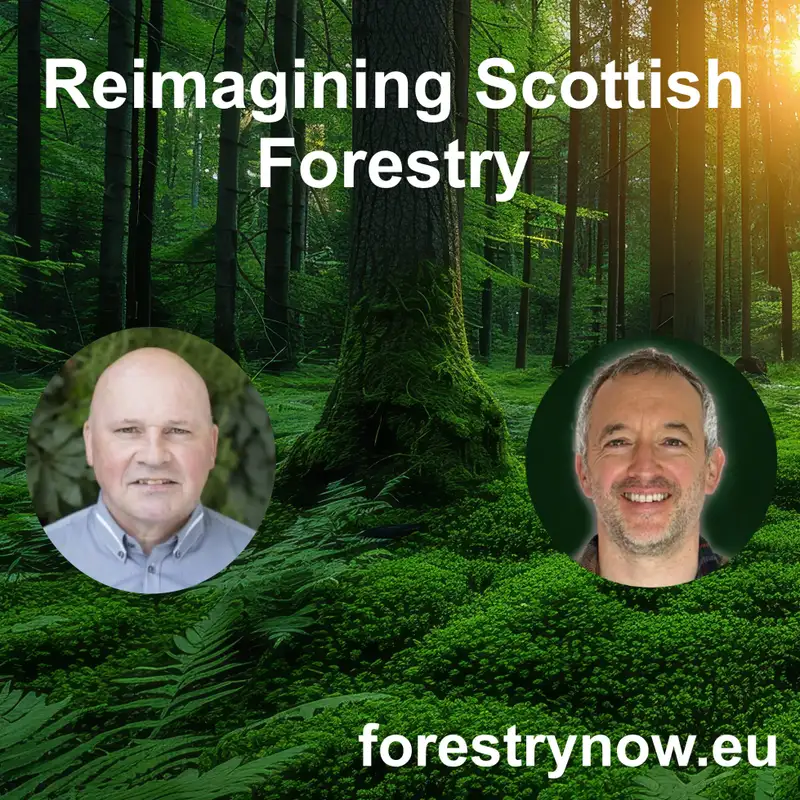
Reimagining Scottish Forestry with Douglas MacMillan
Download MP3speaker-0 (00:01.774)
Welcome to Forestry Now, where we explore the forces impacting profitable and sustainable management of commercial forests and natural woodlands. I'm Dermot McNally. As stakeholders in the broader forestry sector, I think we can all benefit from listening to those who have criticisms about how the industry operates and who it benefits. So today I speak to Douglas Macmillan, who shares his analysis and criticisms of the current forestry model in Scotland. Douglas worked in the industry in the 1980s.
Before moving into research related to forestry and sustainable land use systems. In this conversation, Douglas explains the historical background to afforestation in Scotland, current ownership, species selection, management techniques, and ultimately who he says benefits from the status quo. Douglas gives his views on where government policy and financial support structures are actually compounding the problems he sees. He also questions the wisdom of replanting Sitka spruce on marginal sites.
And this leads on to broader ideas about how Scottish Forestry could adapt to benefit the wider community and the environment more broadly. So lots of food for thought here. As always, get in touch at forestry nowpodcast at gmail dot com and enjoy the conversation.
speaker-0 (01:17.496)
Douglas, thanks a million for joining me.
speaker-1 (01:19.618)
Nice to see you. Yeah. Great to see you.
speaker-0 (01:21.79)
Okay, so maybe Douglas we'd start off and you could give myself and some of the listeners a background to the widespread afforestation of the Scottish Highlands that began in the early part of the the twentieth century.
speaker-1 (01:33.954)
Yeah, I mean the the story of forestry, the modern story of really began with the creation of the Forestry Commission in nineteen nineteen following the the Great War. There was a great need obviously for timber. There was danger that Britain would run out of things because of the U-boats. And so there's a feeling that we had to do something strategic with timber. And the solution at that time, nineteen nineteen, was to buy land on a large scale and plant it with
Commercial timber species. This land was generally on the poorer ground. So it tended to be in the in the southern uplands in the scot in Scottish borders, and also in the highlands, where there was a lot of land that was vacant because the crofters and the small farmers who had traditionally been tenanted that land had either been killed in the Great War or were unable to continue to return there because they were not, you know.
wounded, ill, or in many cases the farm had to be given up during the war because the women couldn't min sustain the farm themselves.
speaker-0 (02:43.264)
Okay, so that's I suppose is the background to the land that was planted. And what did they plant and need I ask the question, but maybe you talk a little bit about that then.
speaker-1 (02:54.422)
The basic idea was timber production, so they focused on planting the most productive species they could get, which at the time was actually Scots pine and Norway spruce specifically. but it wasn't long before you know Sitka arrived. And by the late 1920s and early 30s, sitka was clearly showing some advantages. And being foresters, we we kind of get a bit greedy and think, Sitka, that's the answer.
So we started planning sitcar without any variability at all. And by the nineteen fifties, essentially any attempt at growing sitcar with other species was given up because sitka grew so well. Even on even on dry ground on the east coast, sitka was outperforming pine significantly. And it's only actually in very exceptional sites on very driest parts of the east coast, virtually on sand, that pine can still
out compete Sitka. So SICA quickly took over and was a versatile timber that could be used for lots of different things. But unfortunately, you know, that we never really discovered or thought about utilisation enough. The idea was we need things that are logs that could be used to support pit shafts and and burn and possibly be used as a low quality construction timber.
But we never really thought it out. It was after an afterthought. We wanted things to grow fast, be cut down and produce volume, but we never really got ahead of the utilization argument. And that that's part of the problem. It was retrofitted essentially. The the forest industry has retrofitted to the resource, which when you think we only started planting trees a little over a hundred years ago, it seems a bit crazy, really. And yeah, you know, you do wonder why.
Utilization didn't drive afforestation in a way that one would have thought it would do in a modern in a modern sense. Okay.
speaker-0 (05:00.884)
And I suppose the the drive for production timber, I I guess Sitka or the Conifers would have provided that utility for maybe the volume of of what would be needed. It certainly isn't gonna do everything, but would that be fair enough to say that probably did provide the the pit shafts and s lumber for for building houses?
speaker-1 (05:24.014)
You think Yeah, well, I know I think I think that is debatable. I mean, that is a moot point, I would say. I mean and foresters used to debate these things before they were told not to. But that was a big con subject conversation when I was a student. We'd visit the old foresters and they'd be making very good remarks about Sitka and and over reliance on it, because other species have particular wood qualities, pine and and larch.
For example, Douglas fir is also an excellent timber species, which are used successfully in other countries. And so it's always been growth rate has dominated it. And my own view of that is partly, well, it's kind of an obvious thing to look at. It's we know it, we understand it, we can see it. But also I think it reflects the industry, the fact that we didn't think about utilization enough at the start. We look we wanted growth, we wanted coverage.
We didn't want to be affected by pests. We wanted to simplify the system and we didn't think really enough about quality, timber quality, for example. And species that generate timber quality if silviculture is appropriate. Sitka doesn't need silviculture, essentially. And that we've almost a it's been a victim of its own success. It's a wonderful species that grows extremely fast and gives reasonable amounts of timber quality timber.
And it doesn't need any silviculture. And that means it doesn't need any foresters. And that's the situation we're now in. You know, there's hardly I don't know many foresters that spend their day in a forest. certainly in the kind of commercial sector. Some small private estates still do it. So sort of allow it some older guy to wander around doing his silviculture and and and measurements. But generally it's all done remotely.
And foresters are just passing visitors in forests these days.
speaker-0 (07:23.948)
Yeah. Okay. Well that that does sound like a a situation here in Ireland as well. We we have our volume production, Kilture, the state agency are in charge of that. And then on the island we still have some of those old estates and they will have a more mixed plantation where they will have their bit of Douglas, they might have a bit of Western Red Cedar, they'll have a bit of beech and oak, and they'll have some sitke as well. And you've you've got more of a mixture there and more of a diversity. But I think this brings us on nicely then.
So that's the background to how we ended up with where we are today. But what is the you know, the helicopter view of forestry in Scotland at this point? I mean, what was planted or percentage area planted, conifer broadleaf breakdown, who owns it? Maybe if you could talk a little bit about that, that'd be useful.
speaker-1 (08:09.592)
Well, it's actually quite easy to to t give the helicopter view because it's very non diverse, essentially. You've got the Forestry Commission or Forest and Land Scotland, as it's called today, who own a fairly big whack of of commercial forestry, and all forestry in fact, thirty over thirty percent. You then have another kind of thirty percent that's in the kind of what you might call investment forestry, which is basically people pension funds.
private investors who want a bit of forestry, good returns on land and and the growing crop and the tax free advantages and so on. So they they're another kind of thirty five percent. And in the remainder is a kind of mixture between what I would call the traditional estates, which have always had forestry in the mix for local they had maybe had a a sawmill at one time. They produced their own fencing, they service the local community and they employed a few local people.
When that sector's declining because obviously land is is being sold off there and they're also now adopting Sitka as the go-to species because we've lost all these foresters that you know those old timers are are are not there anymore. And then you've got a very, very surprisingly small sector. Everyone talks about rewilding and nature woodlands and you know, we've got Woodland Trust and RSPB all planting wonderful woodlands.
But it's a tiny, tiny percentage. I reckon it's less than two percent.
speaker-0 (09:39.75)
On the whole forest area. And Douglas, in Ireland here we'd be familiar with the small farm forestry. Anything from eight hectares to maybe thirty or forty hectares of on a big farm that was planted. And and there's said to be twenty five thousand individual forest owners. it could be a husband and wife, could be a a a single man living on his own and the farm used to decide to plant it. Have you got many of those people? Because we seem to be moving from very big i i are there many of us over there?
speaker-1 (10:08.898)
virtually none. You're rarer than a Capricale, I think. To be honest. We've never had small land owner small forest owners. There's historical reason for that, of course, because forestry or woodland was never owned or managed by farmers. It was always the the laird who owned the forest. So the tenant farmer was allowed to have cattle and sheep on the improved ground or the rough grazings. But the woodland was retained by the owner.
That was partly for sporting reasons, you know, be able to shoot pheasants and so on, but all and deer. But also it was a traditional thing of the of the kind of the feudal system, if you like, that kind of permitted up to Scotland from from down south with the Normans. Woodlands were seen as the landowner's business. And that's why we couldn't get farmers interested in planting trees. There's been lots of schemes.
I've lost count of the number of schemes I've tried to get farmers to plant trees, but generally they're quite resistant. And I think that goes back, you know, to the differences in in land reform history between Ireland and Scotland, particularly. We didn't have that breakup in modern times where forestry was an option. We do have community land ownership now, which is something different to a small, small landowner, but very few of them are in forestry.
And I have to say that the forest industry have been very clever here. They took a very good game when it comes to community forestry. If you're a local community with a sick of spruce plantation, you can walk your dog in there. If you're really keen, you can put up a fence. But you won't get a share of the benefits. You know, the the benefits, the t the timber is all locked up with the giant the large scale processors here. That's another problem. And the forestry commission have been really part of that.
So there's no room for the small guy. There's no small saw log processing. There's no market for small woodlands. Because sickka requires quantity. You know, you need to have, I would say, clear fells in excess of a hundred hectares to even make it attractive to somebody to set up a big machine and go in there with these guys and and tear out the timber and move on. They're not interested in coming into tiny little pockets.
speaker-1 (12:30.122)
And set up big machines. That whole system is geared to scale, large scale processing, large scale harvesting. And so you've got a system which we would love to have farmers planting trees, but I don't think it's ever going to happen unless farming collapses. And that that's a possibility. You know, that is a possibility in the future that farmers give up. And then we'll have then we'll have trees, but there'll be no farmers. It won't be farmers planting the trees. There'll be whoever takes over the land.
You know, and we we have already have examples of that where land has been taken back in from farming and put into trees. But it's not the farmer that's doing it, the farmer's gone.
speaker-0 (13:10.818)
Okay. No, I I hear ya. the the interesting point there I'd I'd throw in the mix is that we're well aware that the timber industry is a global industry. So albeit that that the that the Scottish timber production is highly geared towards Sitka, as is the Irish system, it doesn't enjoy for for all the intensity that we have here in the UK and Ireland, for all the intensity and the scale that our mills
enjoy they they don't enjoy a cost benefit. There's huge amounts of timber flooding into the UK because the UK can't produce its own timber and Ireland exports some across to yourselves. But it's not that we have a premium on our price. So I th the point I'm making there is that yeah, it's it's we we live in this global context. And even though I see your point, it's hard to imagine a situation where Sitka could
bring more returns to the local market without effectively becoming uncompetitive, if you know what I mean. There's times when there's more money in it for the for the farmer owner, the price fluctuates. But it is an inter it it is very much an international commodity. We're very disadvantaged by that, I suppose.
speaker-1 (14:21.078)
That's definitely the hegemonic narrative that forestry com forestry land Scotland have bought into and the private sector put their weight behind Confort, for example, is that we need more timber and but we need it to be efficient and to be able to compete with imports. But to me there's a bit of a lie in there that no everyone's scared to say, and that is if you were genuinely interested in competitiveness, we we wouldn't have
Profitable forestry. We can bring into our much cheaper. Now you say, well, we need national security argument, which is fine, I accept that. But what exactly is that? Are they imagining the German U-boats striking out against from, you know, from Kiel and destroying our import business? I don't think so. So yeah, there's a lot of I get it. I get globalization and I get economic efficiency.
But I guess I think when you start really drilling down to that, you think, well, is it really worth it to put all your kind of eggs in one basket? Isn't it better to have a policy where the trees are for people, for people to grow, for people to enjoy, for people to get benefit from? If it's just large corporations looking for handouts from governments saying they're the most efficient, there's something all right there. If you're saying it's really efficient to grow timber, sick of spruce.
in large areas of the country, then why do you need tax breaks? And why do you need grants? Why should the public subsidize a purely commercial model? We don't subsidize anything else in that way. And you know, this is where we get onto this kind of is Sitka a multi purpose woodland? You know, and that that that to me is one of the biggest false narratives in the whole business because it's s the circularity, everything goes back to Sitka.
But none of Sitka's arguments actually stand up to the light of day if they were properly scrutinized. I mean, I'll give you an example of that. I mean Demmer is that I d I was involved in probably one of the biggest valuation studies of of forestry in Great Britain. Well it's about twenty years ago now. They got all the they all got the almost, you know, the most famous forest economists in the country, plus me, to do it.
speaker-1 (16:45.106)
And you know, that was my area evaluation of forestry non market benefits. And it was a good study. We used the best methodologies, but they did not want us to look at species. They wanted us to review the values generated by forestry. But they they didn't allow us to look at sick cut and compare it to Douglas Fir or Scots Pine or Native Woodlands. And so they we got this huge number.
And before you know it, sick of spruce plantations are worth this huge amount for recreation, for tourism, for conservation, because they did not look at species or silviculture. You will know that the value of a woodland to society is partly species, but it's mainly silviculture. The way it's thinned, the way it's managed, the way crops are are replanted.
That's the key to public benefits. But that is suppressed in the whole debate because the sitcom model is requires large clearfelds. It can't survive any other way. And that's why I say there's a problem with the model. Unless you want to go to these huge kind of colonial plantations and say, Well, it's okay for timber security purposes, I don't mind if all that money and all that land is given over to huge corporations which are owned by foreign.
Foreign companies or certainly not local companies. And this is the kind of n the kind of narrative that we're meant to accept all the time. And people largely do accept this narrative. But
speaker-0 (18:25.406)
just on that then, Douglas, I mean, you're basically talking about we've got we're talking about I'm trying to sell the advantages here. We've got a commercial crop and it's efficient to produce and it's providing timber into our construction industry. So that's one argument. And then you're highlighting disadvantages. So effectively what you've mentioned there is we've got concentrated ownership of forestry in certain hands and the the profitability and the benefits are going to
larger industrial organizations as opposed to widespread number of owners like might be the case in in in to some degree in Ireland. You're also mentioning perhaps that the forests are not good from a public or from a I suppose a public enjoyment point of view. So maybe let's expand then and and mention some of the other disadvantages that you see apart from those couple that we've kind of touched on so far.
speaker-1 (19:22.626)
Well, I mean you gotta look at if you look at other policy priorities for rural areas, Sicker Spruce doesn't fit many of them, to be perfectly honest. The benefits are shipped out to mills which are largely in the urban or peri urban areas where there's lots of employment opportunities and choices. There are no jobs in local areas now. There are no permanent jobs. People move in and move out. So in terms of rural employment
Forestry is pretty disastrous now. It wasn't always the case. But Sitka drives that. Sitka and the commercial sort of like economies of scale argument drives that. So that's one problem. But from that, lots of things cascade out. Rural housing, rural schools, rural health care all suffer because forestry doesn't provide any jobs, employment in these areas. So in the remoter parts of
Northwest Highlands. And by remote here, I'm not saying that remote. I'm I'm talking about outside of Inverness, in the kind of Inverness area, Greater Inverness area. There's virtually nothing. People are leaving. We're having a clearance of people because there's nothing. Don't want to go into farming anymore, because again that model is is is groaning badly. And forestry offers nothing. Absolutely nothing to to people.
They're not engaged with it, they don't have the skills. We've closed down, you know, forestry programs, training programs. Why, you know, when you think about why the closed Alberine University's forestry program, we think they don't need clever people in forestry anymore. And it's true, you don't need people with degree qualifications, because what you need is an accountant, a spreadsheet, and a giant forwarder. And that's forestry. So
I'm getting off your point here, Jim. I'm sorry about that.
speaker-0 (21:20.734)
No, no, you're okay. No, I it's it's a fair point. And the employment issue, especially with mechanization and and I suppose the the way the economies scale it just drives on this merciless machine that just keeps growing. But I mean you did acknowledge a stark reality is is that simply removing forestry or there isn't a clear alternative for rural employment. And you have an argument, and we can maybe touch on that later on, that
different model of forestry might bring more benefits to communities. And and I just wonder, you know, we can click our fingers, import all our timber, and I'm not sure that we're gonna necessarily solve the rural decline debate, because we have that in Ireland as well. And agriculture, farming, livestock and and trying to make a living off that is is challenging as well. So so we have that. Another disadvantage I think we had chatted about before, an effect on tourism. Why do you feel that the Sitka is
the monoculture clear cut is is a serious detriment to that or does it does it happen anyway?
speaker-1 (22:24.076)
Well, this goes back to my comment about market benefits. I mean, f forestry's come up with some ludicrous estimates of how many tourism jobs Sika Spruce supports. I mean, it's something like 18,000 jobs in rural tourism due to Sika Spruce. I mean, it's just a joke. The methodology is suspect, but they needed the headline because the reality is it doesn't support tourism. Tourism is the biggest industry in the islands, and it's incredibly important.
But we've we've not woken up to the fact is that you need to coordinate strategy for tourism that supports a vision for where you want to go. And I I can see, you know, I'm a forester, so when I go and see I just see these big blocks of sitka in some beautiful landscapes, and I I you know, it's a crying shame. And I think that one day that'll happen to most tourists. They'll probably be get wise up to the fact that.
The highest is not an industrial landscape. It's it draws its attention because of you know its wildness, its remoteness, its naturalness, its romanticism. How do you feel if you're on a romantic break from Spain looking for an outlander location and you come across a giant forwarder you know who's who's ripping out the trees with gay abandon? You know, I I just don't get that. I think again when you talk about profitability.
national security, that's a pretty big hit to tourism if you've got an industrial process there. People want to see people, you know, when they're on holiday.
speaker-0 (24:02.632)
Yeah, I mean, are you not contradicting yourself there? If you're saying that tourism is already a big industry in Scotland and we already have a big timber industry, I mean, again, from the Irish perspective, they do sit alongside each other. And I'm gonna tell ya that a lot of your average tourists, when I go somewhere, I kind of accept the landscape as I go there to see. And when you look through the eyes of someone who's highly critical of the forestry sector, of course you're gonna see that. It's gonna jar you.
But I remember driving up through the Scottish Highlands before I got involved in in forestry. And you know what? I could see the landscapes that have been cleared of native, you know, trees for grazing sheep and whatnot. And I could see the commercial plantations, but I still enjoyed all the benefits you're talking about. So I I think they can coexist and they are coexisting at the minute, Douglas.
speaker-1 (24:54.018)
Well, I think I think I would probably disagree with you there, Dun. But I think you might be trying to draw me out there. I I I think when you see a giant clear fell of a hundred and fifty hectares, looking like a bomb, is it? I don't think there's a tourist on earth who would say, Hmm, that's nice. Do you? I mean
speaker-0 (25:15.374)
No, I I I you're a hundred percent right about that. That's you know, the Clearfell is is not a particularly enchanting sight, no on your holidays. No, I accept that point.
speaker-1 (25:25.356)
Yeah. I mean there's a landscapes tell stories, of course. And the more you know about it, the the richer that story goes. So I I'm kind of cursed by having a very good knowledge of Scottish landscape history. this is something I've been interested in sin since I was a kid. So in a way it's a bit of a curse because you know I can't I can't see the landscape as a tourist season. A good story I can tell you about this term is when I was working for Tell Hill.
We we worked in the one of the largest new plantations in the country, Griffin Estate in Amberfelde. It was massive. And one of my colleagues took his mother-in-law for a drive up there. I don't know whether he was trying to drop her off in the wilderness or not, but he took her up to the top of Griffin and saw all these young Sitka growing up and she said, Colin, that's that's lovely. Why do you need all these Christmas trees? You know.
So that was her perception. She thought that w we were growing Christmas trees. And that I'm sure there's a lot of tourists like that. I guess the point is that is that if we want to sell Scotland, for example, as a sustainable destination where we care about nature, where it cap people's well beings in local communities, that's the big picture. How does industrial scale forestry fit into that argument? I don't think it does. I mean, I I think we can intensify production.
Don't get me wrong, I I think it'd be great if we can intensify production. I'm all in favour of super sick car. I'm all in favour of intense production. I just don't believe it should be in the highlands. It should be on better quality ground, more accessible, and it should be in the hands of farmers who can treat it as a crop. And it can pass that on to their to their children. You can have a forty hectare, you know, wood lot which can grow very fast.
You can thin it, you can do anything you like to it, and that will provide timber very intensively and give somebody ownership of it, control of it, and something that they can pass on. So I think I think there's room for Sitka. Definitely Sitka. And I I just think that it's the land ownership patterns and the way the economy has developed has created this massive divergence between what Sitka offers currently and what I think we could get.
speaker-1 (27:48.032)
And mu something much better.
speaker-0 (27:50.19)
Okay. Well, maybe we'll we'll come back to the future vision for Scottish forestry, but let's stick with the timber processing before we move there. you mentioned that Scotland needs a new timber processing strategy. And so you've already highlighted we've got these massive mills that are specialized. So I'm guessing you're talking there about some encouraging some smaller mills that could deal with diverse species, are ya?
speaker-1 (28:16.078)
Yeah, I think I think long term, e even the industry have kind of recognized that they have to take a slightly different turn here. What's the problem with diversity? I mean, as you alluded to yourself, market system doesn't sleep. You know, there's a I think there's a motto in the Royal Scottish First Society about oak growing while you sleep. Well, the market system never sleeps. And that means it's looking for efficiencies all the time. We don't know where it's going to go next.
How many more jobs will be lost? Maybe some milks will have to actually close because Brazil or China get their act together and start, you know, supplying our our timber market. You know, we don't know. It's a beast that we cannot handle. It's like I think one of the famous American new sort of like critiques of neoliberalism said, you know, market force is like a madman.
Why would you give a gun to a madman in terms of, you know, you gotta get the gun off the madman? And that that's you know, and neoliberalism is take that way. You're empowering something you should actually keep caged up. You know, use market forces, but in a controlled way to get the outputs you want. So I I'm going slightly off track here. And so in terms of processing locally, I think there's a lot of technology we could be looking at, improvements. You know, I I've
I was lucky enough to have some twelve elms I I had processed with a portable mill and I converted the value of the w that from firewoods, which I would have produced myself, to one thousandfold because I can now make furniture with it. And I can sell it for ten times the price, even unmanufactured. I think in a way my regret is that there's no room for any entrepreneurialism in processing, in woodworking.
In adding value. All we've got at the moment are a few guys producing fence posts, which is not a bad thing. But I think we could have stronger tapping into potential, you know, with building houses. What timber do we need? We've got a rural housing crisis in the Highlands. So why are we not thinking about growing forests that can make houses? Why are we talking about yield class?
speaker-1 (30:40.13)
When we should be talking about meeting societal demands. And I think that's where you need diversity. I'm not saying you don't need the big mills. I'm saying we haven't got anything else but the big mills. That's not resilient. That's not sustainable. That's a disastrous strategy, actually. If market forces globalization takes a turn for the worst in terms of those mills, they will close. And then what will you do? That's the problem. You need diversity, you need
Options, you need resilience. And we don't have any of that in Scottish forestry.
speaker-0 (31:15.148)
So then maybe we talk about the forestry grant system in Scotland. I'm not familiar with it, but I mean it sounds like they should be supporting small scale mills, mobile mills, and maybe training people up at the fringes. I mean, we we accept that there's gonna be the large scale, but there needs to be more happening at that side. So, I mean, are they supporting small scale sawmilling and training and and getting other things happening?
And is there other problems with the Farsa grant system in a more general sense?
speaker-1 (31:46.774)
I suppose. Yeah, I mean the the short answer is no they're not. because they they focus on traditionally forestry grant schemes always focus really on what your plants. After that, they're not really interested in it. And so that is one major critique. Again, go back to the point I made about we're not focused enough on utilisation. They're thinking about they're under pressure to maybe have less sitka spruce so they require more hardwoods.
Despite the fact the harbors would all be eaten by deer. But they can't do anything about deer policy because deer is not in their concern. It's nature Scott and the sporting landlords that control deer. Well, not nature Scott control of it, but the regulatory terms they do they do. And so we've got a lack of kind of like very disjointed policy that means what Scottish Forestry, that's the name of the government agency. We used to call it Forestry Commission.
Are interested in getting trees in the ground. They don't look at natural regeneration. I think less than four percent of all new woodlands in Scotland in the last eight years have been through natural colonization, which is incredible given that all you really need to do is control deer and you'll get it. You know, we know that. But still, it's just about planting and fencing and ploughing or scalloping or whatever it is they do now.
And they're they're just thinking more and more it's all about planting targets. This has been one of the massive problems that that processes, etc., are cleverly used. We need to meet our planting targets. Well, who said the planting targets and what do they mean? No one knows. Why are we looking to plant 18,000 hectares a year? No one knows. It sounds like a good number, I suppose. Why are we not thinking about let's increase GDP regionally of forestry?
Why not set that as your policy target? Why not say that in each region where we have a forestry industry, we should be reaching doubling GDP contribution to growth from our forest reserve. We don't do that. We stick on planting targets and that's it. So I would like to see, in terms of forest policy and support, going much more towards management and siliculture and utilisation.
speaker-1 (34:14.85)
Forget planting grants. You know, that that's too much tied into land value appreciation. You know, if the product's good, you don't need a planting grant. What you need is support to get the product, a good product. And the Confort and the the Sitka Boys have done that brilliantly. They've told it the only product in town is Sitka and the big mills. And I don't believe that. I think we just haven't invested in alternatives. And we shouldn't under
Estimate. I know in this world of neoliberalism, I sounding like a dinosaur, and I may well be, but the point is I understand the economic system pretty well. And I do know that government involvement is critical to every single land use in the country. Farming, tourism, sporting. There is a policy that's fundamentally important, and that's why we're kind of locked into a system.
is because if you change it, someone's going to lose out big time. So government policy is very important, even to the neoliberalists who think they're very efficient and profitable and don't touch us. They require subsidies. Same with farming, same with everyone. They need help. So what I'm saying is why don't we think about what's available to help them and let's see if we can get a better system out of this that actually works for people and works for different locations.
Why does it have to funnel all the benefits into multinational corporations? That's an important question, you know. That we cannot why does forestry not even want to discuss that? That's what strikes me as amazing. We've got all these institutes and agencies wanting to develop rural areas, but forestry can ignore them all.
speaker-0 (36:02.584)
You're giving me a a slant from Scotland. And my take on the Irish situation is that at times we have independent agencies that are pushing, as you say, farming, pushing tourism, pushing forestry and they they're all got their own agenda, their own targets, and they're using their own resources to push their own area. And it takes a very powerful and strategic view to come above all of that and to start to pull it all together. So I I think we have that in common.
'Cause we'd have critics in Ireland who'd who'd say something similar. I want to move on to something else you you you said in our pre chat, Douglas, is the idea that not only we've we've highlighted the fact that there are grants involved in Scotland as there are in Ireland, but you actually say that on many sites it doesn't make sense to replant Sitka after it has been clearfeld. And I'd like you to talk a little bit about why that is.
speaker-1 (36:59.67)
mean, that's an interesting thing. This goes back quite f back just in my career back into the nineteen nineties. I I did an analysis of the economics of replanting. And even if you give accredited Sick of Spruce and Lodgepole pine plantations on the more remote sites, the higher sites, subject to windbowl growing around about U class eight to twelve, they're not economic. Even was you give them incredibly ridiculous.
benefits for recreation because no one goes there. I don't know anyone who's ever been in these forests, not even the forester. They're kind of at the top of the hill, at the end of the road. They blow down, but still we manage to replant them, even though they're totally uneconomic to do so. Now the argument for that is what we've said before is that we need the fiber, we need the material, the processing mills are burning twenty four hours and we need that material. But it's not economic, right? So you can't have it both ways.
You can't say sick is the only economic option in town and then ignore economics because it suits your purpose. The other part of this argument I'm making is that we have rewilding. Okay. And quite really people want to restore native woodlands. We want natural processes to lead. And we can create fascinating wild spaces. Now I I get that. And kind of sympathetic in a way to that. So
I made the argument, well, why don't we rewild these uneconomic plantations? They're perfect. They've got trees, they've got no one goes there, they're remote. Why not just let the trees fall over and let them decay and let's see what comes out? Brilliant rewilding, I would say. But not even the rewilders want it want these plantations because it's not pure enough. They're worried about sick invasion. And critically
It's not attractive to them as an investment because they can't buy and sell the land. This is state land. And this is when you begin to unravel even the rewilding debate. It's more about land values and land value appreciation than it is about forestry. No, forestries have always been taken for fools. You know, we've always been tolerated by the the investors, you know. But actually, it's not good forestry.
speaker-1 (39:25.96)
We're not thinking outside of the box enough because we've got this into our mind that if you got a forest you must replant it. And typically, you know, the last time I looked, there's been a little trick done to us here, and that is for a long, long time, broadleaf targets and so on were were for new planting only. Replanting was ninety-eight percent of Cicus Bruce, regardless of what was there before. Now
That's kind of changed, but there's still that problem. It's and it's it's not economics. This is the thing, you cannot say that's economic to me. It's not. It's uneconomic. You need to do something else with that land. But they're not prepared to do that. I would, for example, re wild it. I would rent it to a charity who wants to rewild it. Do something innovative with the land. You know, get people into hunting deer, you know, get community opportunities. But no.
It has to be sicker.
speaker-0 (40:25.678)
If d just before we move on to the future vision for Scottish Forestry, where we'll pull all these points together, Douglas. I'm interested in that area. First of all, my in Ireland the you can't plant Sitco unless it reaches a yield class of fourteen, I'm gonna say. Now I'm not a forester, but if you have land and you want to plant and it meets all other criteria, it must be able to produce a productive crop. And I know from doing the math and having a sister who's an accountant.
If it's not gonna give you a return in a certain number of years, you'd be better off not spending the money on replanting it. So I I I'm with you there. And if it's gonna blow over, it's low yield clash, you have to insure it, you have to do all this else. Okay, so that we're both agreed on that. And I think that is a problem. It is a problem here too. and we use the excuse that there's a replanting obligation. Well yeah, but we I mean we have to think broader than that. But here here's another crux, right? Which is
You also mentioned earlier in the conversation that many Scottish farmers are very reluctant to plant trees. And the brutal reality is that for anyone who has planted large areas of broadleaves, there quite often is no financial return from that. It's very, very difficult to get a financial return. And the idea of covering large thways of unproductive former conifer sites with native woodland is amazing to me.
But you know that the society doesn't value that enough, doesn't value the carbon sequestration, it doesn't value the the biodiversity benefits, it doesn't value the water quality enough, or the improvements to water that the the trees will offer. So we're in a crux here because we we do want more of what you're talking about. But unless government steps in or industry or somebody steps in to say, listen, let's remove those unproductive areas, let's create this.
forests we want to see for the future, then it can't happen. We're we're in a a crux there,
speaker-1 (42:24.206)
Absolutely. But the there is a solution and that, as you've said, is government policy. You know, I I think and it is also this idea of I mean one of the key things here, well when I got some reaction from the rewelding sort of like lobby, if you can call them that, is that they're happily spend millions buying a piece of land and then planting trees and putting up fences and getting grants and donations to do that.
I said, well, why are you spending millions when you could use spending thousands, only thousands, to rewild these uneconomic plantations? And basically the end the day is that the money's in the land. Their model is to replant land and then sell it ten years down the line, or biodiversity trading, or whatever it it is. That that's in their model. It's not philanthropy. Okay, fair enough. Fair enough.
These areas are not prime rewilding areas. You know, they won't look pretty. You won't be able to use them in your PR. But the state have an obligation to manage resources properly. We're in a biodiversity crisis. We're in a climate crisis. These areas would be better managed for biodiversity and nature if they were not replanted and they would save money. Lots of money. So
I'm I've yet to hear an argument why they're doing this other than the processors need timber.
speaker-0 (43:58.6)
My reaction to that is that you hit the nail on the head. The rewilders, not all of them, but some of them just want that marketing image. They want to bring people out on the ground to a green field and put a clean shovel in a cr clean piece of sile and put in a new sapling straight out of a bag. They don't want to wait for nature to do its own thing. They don't want to walk through brambles to get to the big oak tree that's on the far side. They just want
They just wanted picturesque. And I think we have a sanitized version of nature because we live so far away from it. I drew a a friend of mine who was on a day off into the van and we went across to look at one of my forests. And when he got there, you know, I told him to bring the wellies, you know. And he I don't know. I think he was expecting a lush green carpet underneath him and maybe some kind of a a tarmac pass winding through my woods. It's not like that. So so I think we have a public
perception issue as well on top of all of this, as long as along with government policy and all that. But Kamir, to to bring our conversation to a to a close here, can you just re encapsulate your future vision then for Scottish forestry going forward? And we'll go at it like that, maybe.
speaker-1 (45:10.294)
Yeah, well thanks. I mean it's it's difficult to encapsulate everything because I'm sure there's lots of questions around my vision. But I I think the key thing is to recognise we what the forestry we have is a result of specific circumstances that have sort of self perpetuated a story about needing timber and so on and we need to pick the best timber species grows quickest and so on. That that's the argument. And I've as I said before, I think that was the wrong argument.
It's an understandable one for the time, but it the argument should be what timber is most valuable to us as a society, whether it's in GDP terms or in well being terms. So I think we need to rethink forestry policy to to find out how forestry can make its biggest contribution to well being or GDP. And we have to take account of inequities and social.
disconnect between where the benefits are and where the costs are. It has to be an equitable policy, has to be sustainable. So what I want to see is a bigger focus on where wealth is being created and whether that wealth stays in local areas. And that you're looking there at processing particularly, we need to look at ways of adding value, for example, and contributing to other societal needs. Woodland supports society.
It doesn't support big processes. It shouldn't, at least. And that's what we have. So in terms of an example of that, I think I should be thinking about forestry in terms of a a new strategy. That strategy should be looking at what do pay places that grow trees need? Do they need rural jobs? Do they need rural housing? Do they need to keep schools open? Let's forestry. Let's support that aim of forestry. And of course we need to be efficient. We need to be economic.
But it needs to be moderated by what we want for forestry in these areas. And I don't want to see the highlands covered in birch and you know, and the assumption that somehow thousands of people are going to spend millions of pounds visiting a landscape of birch. I don't believe that for a minute. What people need are well worked landscapes that have farming in it, that have woodlands in it, that have people in it.
speaker-1 (47:33.804)
And that's what policy should focus on. And it that's not what we're getting. We're getting you know yourself that that you know, in Scotland we're you know, the farmer next to me, he's retired. And he, the new guy that's replaced him, has tripled the number of h head of cattle he has on the land. Tripled it. Because he's trying to make money. And this is crazy. We're flogging the ground that we rely on. And it's the same with forestry. We need to realise that
We have to have wider responsibilities to manage the environment for nature, but also for people. Not for industry, not for GDP reasons and investor reasons. This this is going to drive us into a cataclysmic sort of situation. And we're already seeing the wheels coming off, water quality, you know, carbon leakage. It's all happening. And we need a forest policy that's nuanced.
To all these other policies. You know, it's we can't have a forest policy based on producing sicker spruce because it fails, it doesn't tick the boxes rural employment, rural well being, tourism, environment, you know, well you know, livelihoods, none of these boxes it ticks. So why are we supporting it? If you want to plant sitka, if the big mills need sickka, you can buy the land and plant it. I have no beef with that. But
Why is the government using taxpayers' money to subsidise it?
speaker-0 (49:06.398)
You had mentioned as well a term bringing forestry down the hill. And that would facilitate the removal, especially of some of that very unproductive conifer plantations, allowing a more creative and nuanced use of that land. And then bringing forestry down into what we call that the lowlands, Douglas. But how can we incentivize landowners or how do we get them to make that decision? Because we we face the issues in Ireland.
as in Scotland, that getting a people to plant forests in areas that perhaps have less forestry is a massive challenge.
speaker-1 (49:44.962)
Well, y you come very quickly, as you know, up into the agriculture farming resistance and and that is a major policy headache. Things have been tried and they haven't worked. Compromises have been sought, and they were disastrous in terms of getting farmers to plant trees. It's very, very difficult. But I do think we need to look more closely at at the woodlop model where you're managing timber.
Intensively, but you're also managing it in a more dynamic and imaginative way. For example, if you move down the hill, you don't have windfall risk. So your silvicultural options improve. You know, you can open up the canopy, you can introduce different species, and suddenly people are going to start seeing beautiful woodlands. You know, Sikka is actually a beautiful tree if it grows to 120 years, not when it's
You know, a spotty teenager at 40. You know, it you know, it's a beautiful tree. I love walking in mature sitca. It's a beautiful, it's almost cathedral-like atmosphere. I love it. I don't like walking in an untinned sitka plantation that's 30 years old. It's a nightmare from beginning to end. And so I think we have we can we can change perceptions of woodland in the lowlands. We can have timber production and we can have silviculture.
And yes, it may not be efficient, it may not be economic, but that model is driving us potty. You know, it's it's not giving us the outcomes we want. It may sound good, markets work, you know, markets give us the outcomes we want, but it isn't. It isn't. That's why it's not working. And that's why the government needs to take the bull by the horns and say, We need a different type of policy for the get forestry down the hill, get silver culture back in.
get management back in and start looking at local processing. And the two feed off each other. You know, the local processor talks to local farmers, says, Look, if you do this, I can take some of that. And you know, th there's this perception amongst farmers that forestry is dead grand. You know, plant it with trees, forget about it. It's of no interest. But what if these for farmers were silviculturalists as well as farmers? That's the kind of thing we need to think about.
speaker-1 (52:10.51)
You know, who wants to go into farming if it's just intensive cattle, intensive barley? It'll be done by machines, you know, in in ten years' time because there's nobody wanting to do it.
speaker-0 (52:21.418)
Listen, I think the the challenge there and here is creating the structures and the policies and the holistic planning that that facilitates that. Because I know at the minute, if you looked at the Irish forestry grant scheme, you probably think, that's that seems quite progressive. That must be very successful, but it's not. It's it's really we're really struggling. and to get new trees in the ground, we have, you know, twenty percent mandatory.
We've twenty to th thirty percent mandatory broadleaf and biodiversity areas on every site. even if it is in entirely sitka, sitka can only occupy sixty-five percent of a new site. But but even at that, it's it's it's and there's good, there's grants to plant and there's premiums for twenty years. But again, convincing owners to take the leap is is challenging. But anyhow, that's it's interesting to get the the view from Scotland.
Just before we close, Douglas, is there anything else you wanted to add? just put a a cherry on the cake here?
speaker-1 (53:25.774)
Well, I as I say, I think I think we don't value our woodlands well as a society. We we've we've gone we've gone bargain basement. We've got rid of silviculture, we've got rid of foresters, we've brought in big machines, and we all talk just about it being efficient. This is this is a hopeless future for people. You know, I I got into forestry because I love being in woodland and I wanted to see my my work add value.
The foresters don't add value anymore. We have to think about it in a different way. I mean, we've got to use IT, drones, equipment, computers. And contributes to forestry that people want. And that's my big problem. We don't have that anymore. And we gotta see past yield class for a start and and see that that's only part of the story.
And we need to think more widely and I don't think we're doing that at the moment. We've dumbed down forestry too too much and I think we can't sustain this. We are not the you know the prairies of America or the you know and Argentinian, you know, grasslands and we can't compete with that. But what we can have is a multifunctional, complex woodland agricultural mosaic that actually means something to biodiversity and to people.
speaker-0 (54:54.222)
Okay. Douglas, thanks very much for joining me.
speaker-1 (54:56.696)
Pleasure. Yeah. Thank you, Darren.
speaker-0 (54:59.15)
Thanks once again to you for listening, and thanks to Douglas Macmillan for taking the time to chat. All links and details are in the show notes below. And finally, if you're interested in sponsoring the show, recommending a guest or a topic for the podcast, or even offering some criticism, please do get in touch. Take care.