How Forestry Lost the PR Battle with Peter Hasulyó
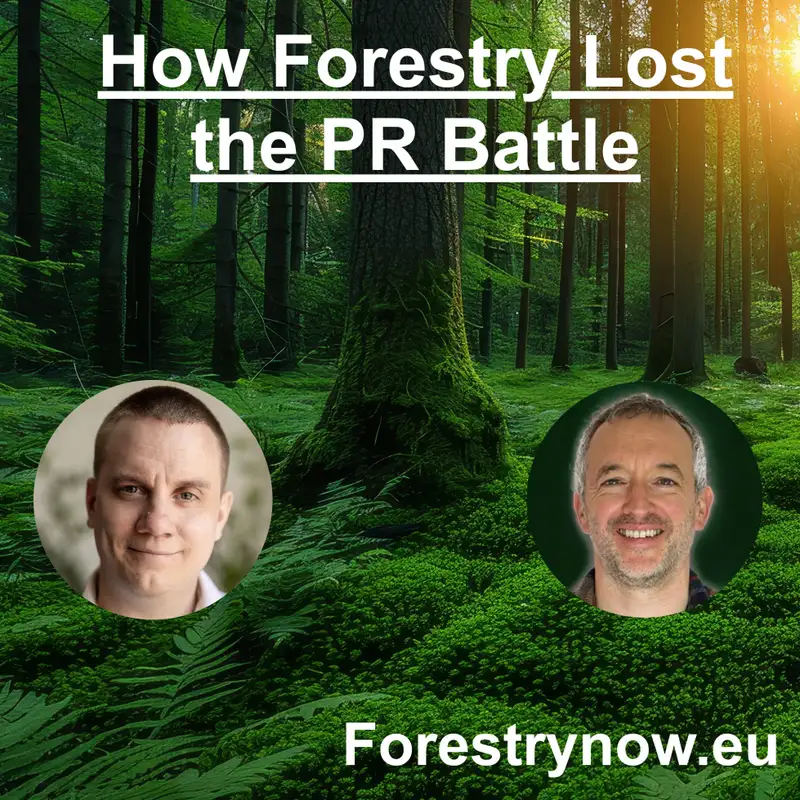
Download MP3In this episode, I speak with forestry engineer and analyst Peter Hasulyó about one of the sector’s biggest blind spots: communication. Despite decades of progress in sustainable forest management, the forestry industry has struggled to win public trust.
Peter explains how a lack of proactive storytelling allowed others to shape the narrative—often inaccurately—leading to confusion between sustainable forestry and deforestation. The discussion explores why perception matters as much as practice, how NGOs filled the communication gap, and why forestry must rethink how it engages with the public.
We also examine real-world consequences of this PR failure, including regulatory pressure, declining trust, and misunderstandings about timber production, clear-felling, and plantations.
Key Topics Covered
- Why forestry lost the public perception battle.
- The communication gap and its consequences.
- Clear-felling vs deforestation: why the public confuses them.
- Forestry as an “open factory”
- The role of NGOs and how emotional storytelling beats data.
- Why timber production is misunderstood—but essential.
- Plantation forestry vs nature conservation.
- Historical mistakes and their lasting reputational impact.
- Regulation (EUDR) as a consequence of lost trust.
- How the industry can rebuild credibility.
Quotes:
"NGOs filled the storytelling gap about forestry."
"We gave them FSC labels. They (NGO's) gave them baby orangutans. We lost."
"An open factory approach can help educate the public.."
"If you don't cut wood locally and source it sustainably, it's going to be sourced from somewhere else in the world, which doesn't have as strict regulation..."
The ForestryNow newsletter signup
forestrynowpodcast@gmail.com
Links:
Peter on Linkedin
https://www.linkedin.com/in/peterhasulyo/
https://www.linkedin.com/in/peterhasulyo/
The Forestry Brief
https://forestrybrief.com/
The PR Battle Forestry Never Fought
https://www.fordaq.com/news/The_PR_battle_forestry_never_111884.html
The PR Battle Forestry Never Fought
https://www.fordaq.com/news/The_PR_battle_forestry_never_111884.html
WWF Hungary
https://wwf.hu/
Chapters
[0:00:00] – Introduction to Forestry Now and Peter Hoshu
Dermot McNally opens the Forestry Now podcast, introducing the show’s focus on profitable, sustainable forest management and his guest, Peter Hoshu, a licensed forest engineer and founder of Forestry Brief, a European forestry intelligence and newsletter service.
[0:01:14] – What Is Forestry Brief and the European Forestry Pulse?
Peter outlines Forestry Brief as an evolving intelligence service built around his twice‑weekly newsletter, the European Forestry Pulse, which tracks developments in European forestry alongside key trends in North America.
[0:01:48] – The PR Battle Forestry Never Fought
Dermot introduces Peter’s article, “The PR Battle Forestry Never Fought,” and asks why a renewable, carbon‑storing sector lost the perception battle in the 1990s, with Peter arguing that forestry failed to explain its work and impact to the public.
[0:02:29] – Communication Vacuum and Storytelling Power
Peter explains how foresters assumed “sustainability would speak for itself,” leaving a communication vacuum that was filled by others; he stresses that in a media‑driven world it’s not enough to be sustainable, you must also be perceived as such through clear value‑driven communication.
[0:04:16] – How NGOs Won Hearts with Emotion, Not Data
Peter describes how nature NGOs, often founded or staffed by journalists, excel at emotional storytelling rather than technical explanations, using simple, visceral narratives that resonate far more than yield tables, certifications, or Excel‑driven arguments from the forestry side.
[0:06:22] – Greenpeace, Baby Orangutans, and Media Optics
Using Greenpeace as an example, Peter contrasts powerful visuals—such as activists confronting whalers or orphaned orangutans losing habitat—with forestry’s dry imagery of labels and tables, noting how these emotionally charged images shape public perception even when contexts differ between places like Borneo and Europe.
[0:07:23] – Clearfelling vs. Deforestation: Same Image, Different Reality
Peter explains how the public often conflates clear‑cut harvesting with deforestation because the initial image—a “scarred” landscape—is identical, and argues that foresters failed to communicate what happens next: replanting, regrowth, and the emergence of a new forest over subsequent decades.
[0:09:24] – The Open Factory and the “Dead Forest” Concept
Building on Dermot’s point about shocking clear‑fell images, Peter introduces forests as an “open factory” that the public can walk into, and explains his “dead forest” idea: harvested timber as the indispensable, often invisible counterpart to the “living forest” that provides everyday products like furniture, houses, and packaging.
[0:11:23] – Long Rotations, EV Analogies, and Global Leakage
Peter highlights how long rotation cycles (30–100+ years) are hard for the public to grasp, and warns that if societies refuse local harvesting while still consuming wood, demand will simply shift abroad to regions with weaker regulations—similar to electric vehicles outsourcing environmental impacts to poorly regulated mining regions.
[0:14:53] – Historical Legacies and Mis‑Planted Forests in Hungary
Prompted by Irish and UK planting mistakes on deep peat, Peter outlines Hungary’s history: massive forest loss after World War I, socialist‑era expansion of low‑quality and sometimes unsuitable stands (including conifers), and today’s twin pressures of climate change and desertification on these legacy plantations.
[0:22:36] – Rewetting the Great Plain and Cross‑Sector Cooperation
Peter describes Hungary’s mixed response of species change, mandatory reforestation, and efforts to re‑wet former wetlands on the Great Plain, noting the need for cooperation between forestry, agriculture, and nature conservation to reverse decades of drainage and prevent large‑scale forest dieback.
[0:24:58] – Why Forestry Under‑Invested in Professional PR
Dermot asks why the sector didn’t hire communicators sooner, and Peter says many in forestry believed a “good product sells itself,” overestimating the persuasive power of data and underestimating how crucial story, context, and perception are in maintaining public trust.
[0:26:06] – Avoiding Greenwashing by Owning Imperfection
On fears of being accused of greenwashing, Peter suggests starting with honesty—admitting mistakes and limits—then working with conservationists and professional communicators to tell balanced stories about both timber production and nature conservation, rather than treating critics solely as adversaries.
[0:27:56] – Collaboration Within Forestry and with NGOs
Peter notes positive joint projects with WWF and others in Hungary and Bulgaria, but emphasizes that the bigger challenge is fragmentation within forestry itself; he argues every forester is effectively a PR person and calls for shared narratives, training, and coordinated messaging across small owners and companies.
[0:29:47] – EU Deforestation Regulation as the Price of Lost Trust
Turning to the EU Deforestation Regulation (EUDR), Peter frames it as a tangible consequence of lost public trust: when voters and policymakers don’t understand sustainable forestry, they default to highly precautionary rules that require foresters to continually prove they are not causing deforestation.
[0:32:44] – Would Better Storytelling Have Softened EUDR?
Peter recounts how some initially wanted intra‑EU forestry exempted from EUDR but external partners objected, and argues that if Europe had clearly demonstrated—and communicated—its sustainable management record, it might have secured lighter treatment compared to high‑risk regions.
[0:33:34] – National Safeguards, Extra Paperwork, Same Outcomes
Dermot contrasts Ireland’s strict licensing and replanting rules with new EU demands, and Peter agrees that in many European countries EUDR mostly adds administrative burden rather than changing on‑the‑ground practice, functioning as a formalized proof of sustainability rather than a new standard.
[0:35:02] – Forestry Brief Services and a Call for Sector Unity
In closing, Peter shares where listeners can find him and outlines his services in research, business intelligence, investment insight, and communication strategy, ending with a call for foresters across countries and languages to network, learn from each other, and present a unified, honest story about sustainable forestry.
https://wwf.hu/
Chapters
[0:00:00] – Introduction to Forestry Now and Peter Hoshu
Dermot McNally opens the Forestry Now podcast, introducing the show’s focus on profitable, sustainable forest management and his guest, Peter Hoshu, a licensed forest engineer and founder of Forestry Brief, a European forestry intelligence and newsletter service.
[0:01:14] – What Is Forestry Brief and the European Forestry Pulse?
Peter outlines Forestry Brief as an evolving intelligence service built around his twice‑weekly newsletter, the European Forestry Pulse, which tracks developments in European forestry alongside key trends in North America.
[0:01:48] – The PR Battle Forestry Never Fought
Dermot introduces Peter’s article, “The PR Battle Forestry Never Fought,” and asks why a renewable, carbon‑storing sector lost the perception battle in the 1990s, with Peter arguing that forestry failed to explain its work and impact to the public.
[0:02:29] – Communication Vacuum and Storytelling Power
Peter explains how foresters assumed “sustainability would speak for itself,” leaving a communication vacuum that was filled by others; he stresses that in a media‑driven world it’s not enough to be sustainable, you must also be perceived as such through clear value‑driven communication.
[0:04:16] – How NGOs Won Hearts with Emotion, Not Data
Peter describes how nature NGOs, often founded or staffed by journalists, excel at emotional storytelling rather than technical explanations, using simple, visceral narratives that resonate far more than yield tables, certifications, or Excel‑driven arguments from the forestry side.
[0:06:22] – Greenpeace, Baby Orangutans, and Media Optics
Using Greenpeace as an example, Peter contrasts powerful visuals—such as activists confronting whalers or orphaned orangutans losing habitat—with forestry’s dry imagery of labels and tables, noting how these emotionally charged images shape public perception even when contexts differ between places like Borneo and Europe.
[0:07:23] – Clearfelling vs. Deforestation: Same Image, Different Reality
Peter explains how the public often conflates clear‑cut harvesting with deforestation because the initial image—a “scarred” landscape—is identical, and argues that foresters failed to communicate what happens next: replanting, regrowth, and the emergence of a new forest over subsequent decades.
[0:09:24] – The Open Factory and the “Dead Forest” Concept
Building on Dermot’s point about shocking clear‑fell images, Peter introduces forests as an “open factory” that the public can walk into, and explains his “dead forest” idea: harvested timber as the indispensable, often invisible counterpart to the “living forest” that provides everyday products like furniture, houses, and packaging.
[0:11:23] – Long Rotations, EV Analogies, and Global Leakage
Peter highlights how long rotation cycles (30–100+ years) are hard for the public to grasp, and warns that if societies refuse local harvesting while still consuming wood, demand will simply shift abroad to regions with weaker regulations—similar to electric vehicles outsourcing environmental impacts to poorly regulated mining regions.
[0:14:53] – Historical Legacies and Mis‑Planted Forests in Hungary
Prompted by Irish and UK planting mistakes on deep peat, Peter outlines Hungary’s history: massive forest loss after World War I, socialist‑era expansion of low‑quality and sometimes unsuitable stands (including conifers), and today’s twin pressures of climate change and desertification on these legacy plantations.
[0:22:36] – Rewetting the Great Plain and Cross‑Sector Cooperation
Peter describes Hungary’s mixed response of species change, mandatory reforestation, and efforts to re‑wet former wetlands on the Great Plain, noting the need for cooperation between forestry, agriculture, and nature conservation to reverse decades of drainage and prevent large‑scale forest dieback.
[0:24:58] – Why Forestry Under‑Invested in Professional PR
Dermot asks why the sector didn’t hire communicators sooner, and Peter says many in forestry believed a “good product sells itself,” overestimating the persuasive power of data and underestimating how crucial story, context, and perception are in maintaining public trust.
[0:26:06] – Avoiding Greenwashing by Owning Imperfection
On fears of being accused of greenwashing, Peter suggests starting with honesty—admitting mistakes and limits—then working with conservationists and professional communicators to tell balanced stories about both timber production and nature conservation, rather than treating critics solely as adversaries.
[0:27:56] – Collaboration Within Forestry and with NGOs
Peter notes positive joint projects with WWF and others in Hungary and Bulgaria, but emphasizes that the bigger challenge is fragmentation within forestry itself; he argues every forester is effectively a PR person and calls for shared narratives, training, and coordinated messaging across small owners and companies.
[0:29:47] – EU Deforestation Regulation as the Price of Lost Trust
Turning to the EU Deforestation Regulation (EUDR), Peter frames it as a tangible consequence of lost public trust: when voters and policymakers don’t understand sustainable forestry, they default to highly precautionary rules that require foresters to continually prove they are not causing deforestation.
[0:32:44] – Would Better Storytelling Have Softened EUDR?
Peter recounts how some initially wanted intra‑EU forestry exempted from EUDR but external partners objected, and argues that if Europe had clearly demonstrated—and communicated—its sustainable management record, it might have secured lighter treatment compared to high‑risk regions.
[0:33:34] – National Safeguards, Extra Paperwork, Same Outcomes
Dermot contrasts Ireland’s strict licensing and replanting rules with new EU demands, and Peter agrees that in many European countries EUDR mostly adds administrative burden rather than changing on‑the‑ground practice, functioning as a formalized proof of sustainability rather than a new standard.
[0:35:02] – Forestry Brief Services and a Call for Sector Unity
In closing, Peter shares where listeners can find him and outlines his services in research, business intelligence, investment insight, and communication strategy, ending with a call for foresters across countries and languages to network, learn from each other, and present a unified, honest story about sustainable forestry.