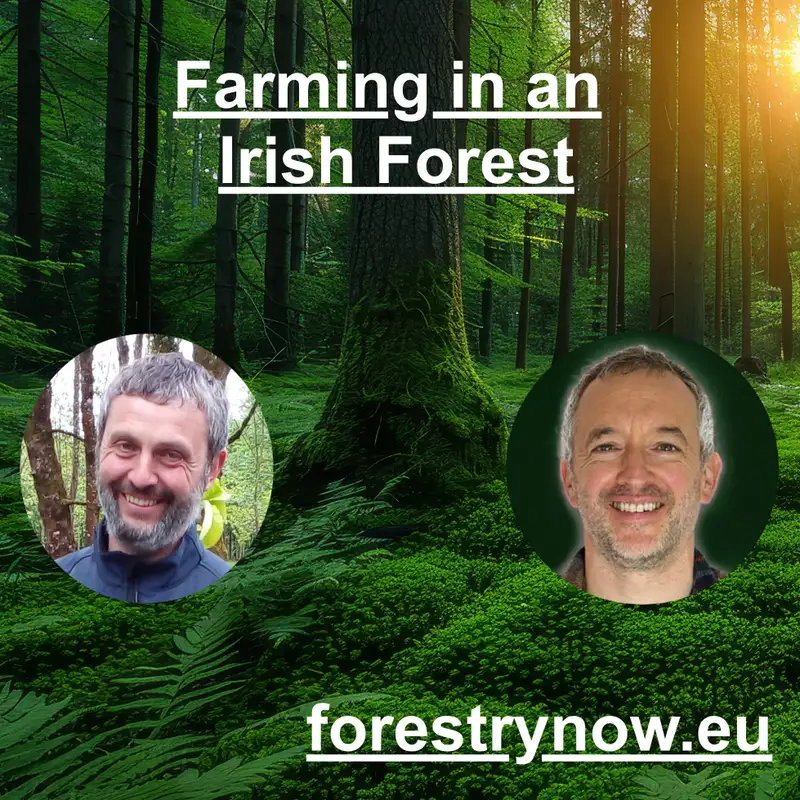
Farming in an Irish Forest with Brendan Guinan
Download MP3Brendan Guinan 0:00
Brendan Guinan is my name. I'm the owner of fear via farm, the only 100% biological agroforest farm that I know of in Ireland. What that basically means is we farm 100% of our enterprise through trees. There's lots of people with with small amount of forestry, and that might run animals through it once or twice. Our farm is embedded in a mixed, diverse forest where we we want the trees to to actually enhance the living conditions of the animals, and we want the animals to enhance the living conditions for the plants as well. So it's a pretty unique enterprise. And then what makes it even more unique is we do all that without any chemical intervention.
Dermot McNally 0:50
I understand that you bought forest back in 2019 so tell us how that came about.
Brendan Guinan 0:55
The short version of it is, I had my own business for 16 years, hazardous waste haulage. When I hit 40, I kind of got burnt out, to be honest. So I sold the business in 2016 by 2018 I had kind of wind out of us, you know, where I was fully finished in it. And then 2019 I literally found the forest. And it all worked
Dermot McNally 2:04
out when you went looking for land, were you looking for land? And were you looking for a forest?
Brendan Guinan 2:08
Good question. I was looking for land number one, but I was going to plant it anywhere, you know, like, and you know, when you plant a tree like, you don't get a benefit from it for maybe 20 years. There are 15 years, you know, it takes time to grow. So when I found this forest, it was ideal for what I was looking for. It was mixed deciduous. There's a little bit of lodgepole pine as well. There was no road frontage. It had been forgotten about, as in, the previous owner had it was left in a will, basically, and it was no real connection to the land. So it was planted, and the gate was closed and nobody touched it for 20 plus years. So it was really overgrown. It was never thinned out when it would come up for sale. Like it was sold when the premiums ran out.
Brendan Guinan 3:06
They didn't see any other value in it. So when I went in to have a look at the land, there was trees down everywhere. The trees were not that healthy either, because they were like carrots that were never thinned out. You know, it should have been thinned out twice by the time, like it was by 25 years old when, when I come in there, and I should have been turned out really 15 and probably 20 or 22 years you know, yeah, there was three every three feet. So you couldn't even get a quad between them, on the other hand, because there was, it was kind of the trees were struggling, because they were all aiming for light and trying to get light. So there were like pencils. The forest floor then was just covered in Briars and thistles and nettles and and gorse. And they were about eight feet tall. And if you actually looked beyond all that, looked at the soil, was bubbling with life. The worm castings were just coming up everywhere through the soil. You could reach into the soil and dig down a foot deep with your fingers. You didn't need a spade or a shovel. That's where I saw the value was actually in the soil. I also saw value in like the trees, when you thin them out, you have the power to create these little microclimates and shelter belts that if you just planted trees now, you'd have to wait a generation for deciduous trees to do that. For you
Dermot McNally 4:30
clarify for me, then, when you were looking for land stroke forestry, was it to get into farming, or were you kind of half thinking of agroforestry planting. Or, you know, where did the animals come into this? Were they an afterthought then? Or were they kind of part of the plan?
Brendan Guinan 4:49
They were always part of the plan of three acres at home. And I on that three acres I have been the previous 18 or 19 years. I was growing. Two pigs, two cattle, 12 hens, six turkeys. Had a grow tunnel as well, and were used the compost from the animals to fertilize the vegetables. And we used to grow about 80% of our food every year. I did that from the time my youngest child was born. Sorry, oldest child, sorry, she's 22 now, so I've been doing this pretty much my whole life.
Dermot McNally 7:45
so you bought the forest. Can you just mention what broadleaf species were growing on the site when you bought it. Then what had been planted?
Brendan Guinan 8:04
Okay, well, what being planted, if all was grown, were two totally separate things. And the sigmoid was planted because the ash die back. I was reading the actual planting plan from from the original plan, and there was mentions that Ash die back was might be a problem in the future. So that's why they picked Sycamore, as in the drier, free drain and soil, then, like we back on to cool the Mona bog, so the heavier, kind of more acidic and waterlogged soil, had red Alder planted on it, which actually done very, very well. And then wrap around the whole site was lodgepole pine. Now we also had a stand of red oak in the middle of it, just one strip in the middle of it, and it's doing very well as well. So that's what was officially planted. But what? What's actually there now, loads of ash grew, loads of naturally seeded oak grew. Have you heard there's, I've one particular oak in the middle of the sycamore plantation, and it's, it's like a beanstalk. It's actually twisted, twisted, twisted the whole way up. And it's, it's about seven or eight feet tall. It's a spectacular looking oak tree. But loads of Willow, Hazel, there's beech, there's Holly, there's Rowan. There's a mixed array of different just naturally seeded trees and plants there. It's really cool,
Dermot McNally 9:36
yeah, okay, and when you went in first to see it with a view to buy in. It was pretty overgrown. You mentioned a bit of wind blow. Can you explain what was happening there? Or had it had the was the ground very water logged? Or how did that end up being the case?
Brendan Guinan 9:50
There's parts of the land that has very thin topsoil, yeah. Okay, so between the. The unhealthy trees, the ones that didn't reach through to get the light, and the shallow topsoil is kind of an under Line layer of kind of impermeable blue clay or marrow underneath the topsoil. Adding the trees that didn't get enough light, didn't develop properly, and some of them snapped in the middle, and more of them just killed over with the rootstock still attached. It was a chaotic looking sight when, when, when I entered it the first time, you know?
Dermot McNally 10:33
Okay, so, so that's how you you got the got the forest into your ownership on the state it was in. So what did you do next? You probably thought about doing a bit of thinning, or what, where did you go about it?
Brendan Guinan 10:46
Well, first thing you had to do was actually clear the roadway into it like there was no, no road frontage. So there was just an old lane way that, at one stage, was used going down into the bog back about 100 years ago, but cool name on a bog was taken over by Bord na Mona Back in the 50s. And they actually stopped everybody from using the you know, they bought everybody off the bog. Any turbo rights were there so they could mill it all. So it was the laneway that hadn't been used in years. So I'd put about 40 grand into the lane to wow, okay, build it up, widen it even clear off the trees that had fallen on the lane. And then I'd apply for felon license, of course. So I looked for a continuous, continuous cover felon license. I did my own agro ecology report. I hired a guy to do environmental reports and all that. So I actually got the continuous cover felon license within about six months. Okay, very good, which was highly unusual because that was around the time when guys were waiting 234, years for felon license. Then I got in with a chainsaw, I got a map of the site, and I drew out kind of a plan, and then I literally just counted the rows of trees on each in each paddock, and just cut kind of roadways through which was easy enough with chainsaw, because the maximum diameter of any of the trees was 12 inches to Know, even though it was 25 years old, Sycamore, and so that kind of opened up the site a little bit. I used a lot of the timber, the long, narrow timber, as post and rail fences for actually fencing the site. I met gates, and I'd done lots of different things with timber, and then whatever was left, someone went into firewood. More of it went into and actually buried us into the forestry drain, drains that would have been dug through the site. Okay to level it out? Try and level it out Exactly, yeah. And and then more of it, we piled up into into big piles. There's kind of like a bee hotel. It was a wildlife hotel, you know. So we did lots of different things like that. And then introduced, well, fenced it with electric fence and post and rail fencing, and introduced pigs, cattle and poultry into it.
Dermot McNally 13:19
Okay, so things are starting to get interesting at this stage.
Brendan Guinan 13:24
Yes, so I use no mechanical intervention at all on the overgrowth that was in in the forest. We introduced cattle first, because the Briars and the overgrowth, like was 878, feet tall. I'd never walked into a site where to know the way nettles are really long and gangly. There was nettles standing taller than I was proudly, like, I'm six foot tall, and I was they were looking down on me because there's so much shelter around there. Could grow up to seven, eight feet tall, which I'd never seen before. I got the cattle in, first, they walked down the overgrowth, and the grazed a little bit as well, and they ate some of the briars. And they wasn't ideal for them nutritionally, maybe, but what it was very good for them was all the trees, because they were struggling so much, they were covered in ivy, and the cattle stripped all the ivy off all the trees, then we'd move them. The cattle on. We fenced into one acre paddocks as well. We kept them as small as we could. And so I had 10 Frisian bull calves. And the reason I used Frisian bull calves were all the information I was given from Chagas can from even my own local vet, they said animals will die beef. Animals will die in there because the rough grasses will have say ticks for blood murn and red water, so when the cattle grew. Is that they'll actually die from from ingesting the ticks. And he said, if that doesn't happen, the deer and badgers and wildlife that live in the forest will give the cattle TB, right? If that doesn't happen, that like there is noxious weeds and stuff in there as well that could actually poison animals. And he said, so one way or another, the cattle are gonna die. So, right, you're mad to even trying it. So I got, I bought 10 Friesian bulls. At the time, there were only a 10 or each. And the reason I it was really just to prove the point, the point I couldn't afford to go buying big Charolais anyway, they would have been the worst animals I could have put in there, because they're too heavy. So the Frisian bulls were ideal. There were light animals. They weren't expensive to buy, and they actually turned out to be really hardy, and they grew like mad. And so that was one, then moved the pigs in next. And the reason I did that was a pig can't lift its head above its shoulders. It can go down as much as they want, but it can't lift its head above its shoulder, so any overgrowth over the shoulder of the pig was inaccessible to it. So the cattle walked all that down within to the forest floor, which meant that the pig could actually really impact the Briars and the overgrowth that was, that was the cattle had walked in with their split hoof, and so the pigs could. They loved it in there, because the soil was so easily dug and so free draining, and there loads of shelter from the trees. So during the summer, the really the direct sunlight, like things can get sunburnt and and then in winter, to hit heavy rain and stuff. So there, there was a lovely, comfortable environment for them. I made sure the pigs turned over the soil enough that the almost like the plowed it and then moved them out. And at different times, like during the summer, you if you left that, that one acre paddock idle for two weeks, it would have the pigs rooting, and the cattle would have woken the latent seed bank in the soil. So there was all this new growth starting to come up. And then it moved the hens in there, and the hens would would spread whatever waste was left from the pigs and the cattle there were actually there were like little tillers just leveling out the soil as well. And and depict lots of grubs and lots of different plants that were starting to grow that the and but they left their waste behind too. And what grew after that was unbelievable, without the animals. And when there was no animals in the forest, and the forest, the whole balance of the ecosystem was was destroyed, you know,
Dermot McNally 18:09
so did you supplement the feed for the animals as well? Or, obviously, there probably wasn't enough there to keep them going. Or, how did you do that
Brendan Guinan 18:19
with the cattle in year one, yes, because even the grasses that were there, like, there were hard grasses, like, like rushes, almost. And now I learned that the result of that was the fungal to bacteria ratio in the soil. Like a forest always has a higher level of the fungal matter in the soil, say, a dairy paddock. Our farmers, you know, fields, just for growing grass, has a very high bacteria rate and ratio in the soil. So I needed to reduce that fungal to bacteria ratio so that more healthy grass could grow basically and more nutritious grass for the for the for the animals like I measured the fungal bacteria ratio in the beginning, it was 60 to one, sort of 60 times more fungal matter in the soil and bacteria. The trees loved it, but the grasses didn't. So we have it back now, just from animal intervention and control tenning, we have it down to about a fungal to bacteria ratio of five to one
Dermot McNally 19:29
and Brendan is that a test that anyone can do? Or how do you how do you go about determining that ratio?
Brendan Guinan 19:34
Oh, yeah, anyone can do it. Yeah, it's very easy test to do, like it's not done in the normal NPK sulfur kind of soil test. It's you have to ask first, but it can be done, no problem. But it is one of the reasons why, if you plant a tree, say, in a standard tillage field or dairy paddock. Will struggle for a long time because the bacteria raise is too high in the soil. So but you can, you can mitigate that by covering, say, mulching underneath the tree with with wood chip, which will help build up our fungal bacteria ratio much quicker for the tree. And so there's lots of things you can do to help us help that tree to grow. But if you just literally dig a hole and plant a tree in a dairy paddock or a tillage field, it could struggle for 10 years before it really starts to grow.
Dermot McNally 20:32
Yeah, there's, there is some, there's some common wisdom there isn't there that the trees like to be with trees really. So the question that anyone who's farming, or anyone who's who has a forest with trees in it, they'd be wondering about the risk of damaging the roots of the trees through the stamping and the hoofing and the digging. So have you noticed any rooting damage or any damage to some of your trees?
Brendan Guinan 20:59
Then, yeah, that was actually another problem from experts that kind of advised me, before I moved into this operation at all. They said that the animals would like kill the trees and damage the roots and damage the bark, and it would just the whole system would collapse. And what actually happened was the opposite. Now, the pigs actually rooted up and mounded up solid rounds of trees. The reason for that is we had small paddocks, and we like if we let, if we just let the pigs, our cattle run riot over the whole forestry. They would over impact some areas, and it wouldn't touch other areas at all. So they would damage trees, and again, in the small one or two acre paddocks that we had before they had a chance to do damage, because they would like a pig is incredibly regenerative, but it's also it can be incredibly destructive depending on the time of year the size of The Pig and ground conditions. So my job, as say, a regenerative agroforest farmer, is to be able to identify when that animal is regenerative and identify the labor unit that animal can create in a certain area until it gets the benefit of that labor unit and move it before it becomes destructive.
Dermot McNally 22:23
Okay, yeah, so your your your eyes were there. You're watching out for the signs, and you rotate it onwards Absolutely. So it's almost like, it's almost like dividing the grassland up into paddocks and keeping the animals moving through the year and giving stuff time to grow behind the animals when they leave. Yeah, and just to clarify Brendan there was no large, clear grassland area, or you don't have any additional grassland area mirror in you that you use at times. So everything is in the forest all year round.
Brendan Guinan 22:57
We've 30, odd, just over 30 acres of land. Now I do have about four acres of raised bog at the very back of that again. And in in the height of summer, I let younger cattle out there just to graze off kind of the the overgrowth from the winter, and it actually lets light down into the into the Heather. And in autumn, there's lovely wild flowers that grow again, so, but that's Jesus. You might get two or three days, maybe, maybe a week's grazing there if the weather's drying up and the cattle love it, but they don't like it for long. You know,
Dermot McNally 23:36
I get you, yeah, so at the end of this, and I know you have a meat box scheme, and you deliver food to different customers, but in terms of the timber output, do you see yourself harvesting more timber, or is the timber being thinned on an ongoing basis as the trees get bigger? What's happening with the trees over the last couple of years, since you did the first thinning in
Brendan Guinan 24:00
different parts of the forest. I've tried out different trials, basically that from pose trials, right? Yeah, yeah, yeah. So I tend really, you know, lovely areas and replanted with apple, pear and plum trees. And just to try and use the sycamore trees as a nurse crop for the the younger trees. I've planted walnut, hazelnut in other areas, and I've tried not to tend too much as well, because it's very easy to chop down a tree. It's not easy for it to grow back again. So I've erred probably a little bit too much on leaving too many trees in places as well. And you can see where you've treated two paddocks the exact same, except for one paddock has more trees left standing, and they there's way less grass in it, because the sun can't get through for photosynthesis with the canopy times of the year, and then we have can. Were much bigger areas, like there was about an acre and a half of an area that had trees struggling unbelievably badly. They were sick more they were only about eight foot tall, through the same age and planted the same time as trees that are 60 foot tall, right? Yeah, I couldn't figure out what was, what was wrong. So I hired a track machine, an excavator, and dug a couple of test holes to see what kind of soil and how deep was the soil and and I also asked some of the neighbors about what published the history of the place. And one of the neighbors told me that that actually was a pond at one stage, back when the end seven motorway was being built, like I'm one mile outside of Port leash, and the motorway passes through Port leash, or it passes within a mile or two of me, when they were digging out the motorway, the council came and offered anybody who wanted soil to kind of level up and from the spoil of the motorway, and the previous owner agreed that she would get topsoil, but she actually got pure lack nothing would grow in it. So the trees, yeah, they didn't die, but they just couldn't get enough nutrients to actually grow, and the roots couldn't go deep enough. So I am it used to flood in winter as well, because, again, there was still a basin and it there was nowhere for the water to go. I dug a couple of ponds in it. I ended up joining that open to one big lake. I took out most of what the Council put in and filled it with fish, and now have a good acre plus of a lake in that area now that herrings come in and rob the fish, and we've ducks nesting on an island that are left in the middle of it, and I use some of that impermeable blue clay to build a cob house as well.
Dermot McNally 26:59
Is the underlying soil? Is it peaty based? Or is it mineral based? Or is there a mixture on the site?
Brendan Guinan 27:04
There's mixture like, when you drive down our laneway into the farm straight away, you're dropping, you know, falling away from the road where you're so you're driving down a hill, you drop, drop, drop, and end up in the bog. So about two thirds of our land is kind of free draining, fairly decent mineral soil, and that's where the sycamore is planted. And then the final third, then it just actually changes unbelievably quick from being fairly free draining to just black and kind of it's not peaty, but a much higher organic content in it. It gets black, and this water logs majorly in winter. So the red Alder loves that, though, right?
Dermot McNally 27:52
Yeah, and it's thriving. And you mentioned lodgepole. Do you make much use of the lodgepole in your paddocks, or are they kind of ancillary at the edges?
Brendan Guinan 28:00
Again, there's lots of trees actually down in the middle of the lodgepole but they're much bigger trees because they obviously grew much quicker. I've used the lodgepole pine as a winter kind of shelter for the animals, because there's 30 plus years of pine needles underneath. You'd actually lie down and sleep in them yourself. Is that comfortable? And I roll out bales of hay in there for for the cattle, and the cattle thrive. I've never had a sick animal in the in the pine forest, because there's fresh air getting through. There's still a really healthy canopy of of shelter, and the pine needles were there. You couldn't muck it up, you know. So as regards value of the timber, I've got a couple of guys to look at it, and they said it's mulch, like you just cleared mulches and replant it. So I did. I got in with a chainsaw, and I cared about an acre tin, sorry, thinned about an acre, and as soon as I opened it up, the rest of them fell. Ah, yeah, okay. It is something I'm just gonna have to bite the bullet with and get a machine in, clear them and mulch them and start from scratch again, replant.
Dermot McNally 29:23
And Have you any idea what you would plant Brendan now that you've seen what's working and what's not working,
Brendan Guinan 29:28
there's lots of silver birch actually growing through it, okay as it is. So I and also that the acre that I thinned a couple of years ago, I planted some rowan berries and some blueberries in there, and they're doing well, okay, so I'd love to get maybe a couple of acres of blueberries going with maybe shout about some of beach or hazel, or I'd rather deciduous trees, if possible. Yeah.
Dermot McNally 29:57
And in all of this, it's a very on. Conventional but very practical, and sounds like a great way of managing the animals and working with the forest, but how have you found the department to work with on this? Because quite often, if things are written in a rule book, they find it hard to deviate from that. Have they been flexible with you, have they turned a blind eye? Or do you feel you've got support? Do I feel
Brendan Guinan 30:24
I've got support? No, is the answer on that. I haven't needed them. I do need to TB test my cattle each year. That's the only time a vet is on my farm. Now, not because I don't believe in vets, but I don't need them, like the animals don't get sick. The only grants I've got is the continuous cover fell in license, and I'm Grant for that. I got no grants for animals. My land is not eligible for organics. I tried to join the organic scheme, and I couldn't get any funding for that, because it is officially still forestry. Was planted as as as commercial forestry, and so I've got no agricultural grants. I've got no environmental grants, so I don't really have inspectors coming out checking what I'm doing. Yeah, yeah, for that reason. So the only way I make money is through sales, direct sales and marketing for other produce.
Dermot McNally 31:23
Yeah, no, which is, which is fine, and it just just a curious one, because many people are moving towards agroforestry, but there's other people like yourselves, who maybe have a bit of forest that was planted beside them or planted at the back of the farm. And some of them are, are like you, they're starting to integrate that into their farming activity. So you're just you seem to be further down, and you've brought a lot more diversity into how you're farming the forest effectively than anyone else nearly that's out there, just in terms, again, of the forest and your plans for the future. So have you any plans to expand the area under management? Or would you take on more forests to do the same? Or are you just happy with what you're managing at the minute this
Brendan Guinan 32:10
year, say, 2026, of several plans, short term, medium and long term. And the long term plan is going to be intergenerational, and that's really the big picture, I want to design a system that actually attracts, if not my family, then somebody else that will be interested in taking it over, which is one of the major problems with agriculture. At the moment, they don't have a succession plan. Most young people are walking away from agriculture because they don't see a future. The plan for 2026 is actually to turn my farm into a demonstration farm. I was doing it this year as well. To a certain extent, like we hold open days, we invite farmers in who are interested in seeing how they can incorporate their some forestry back into into productive land use again, but without damaging the trees, you know, so Demonstration Farm short term for training other farmers and and also, it's really just to shout from the rooftops what's possible. It's amazing, like, and it's way beyond what I thought was possible, standing back and just letting things happen, you know, like we over impact ourselves with too many sprays and too many, too many big machines coming in thinking you're doing good and you're actually doing so much damage. That's the short term, the medium plan. I want the found to become a destination for for the general public, so the building, the cob house, is, it was a kind of a test to see, is it possible maybe to build accommodation on the farm with the resources of the farm, which would be one of the core principles of regenerative farm, and use the resources you have on your farm, first to its greatest potential before you start looking to import. But if it's building materials, or if it's nitrates to get or whatever, you know, you use the resources you have. So we built that one cob house. It's a test case. It's working really well at the moment, we we dug the lake. It's full of fish. We've anglers that come in and fish as well, and we teamed up with local archery club. We've had the National Archery championships on the farm for a couple of years. Well, okay, so we're we're building. Next year, we're going to build a community garden on the again, nestled in a paddock in the woods where we're going to have some allotments. We're going to have some grow tunnels. We're going to set up grow your own, you know, bring in general public and run grow your own class. Stuff like that as well. So, so that'll be the medium term to actually see how many incomes we can actually generate off that one piece of land. Yeah, yeah, yeah. That will help the long term plan of succession. Then, yeah,
Dermot McNally 35:15
once it's viable, yeah, yes. I wonder. Have you thrown your eye over the new agroforestry scheme, or have you gone to any demos? Or have you any opinions on it or how it might work?
Brendan Guinan 35:27
I have, yeah, I have, the payments are very good, okay? Have one problem though, right? And that is, if you're convincing people on payments only, it's a very shaky foundation for any scheme. And I know lots of guys who who are interested in agroforestry, but they're petrified to tie up their land for trees in case, like they lose control of, say, thinning. You know, it's the felon license and that it's going to devalue their land. And all the, all the here and see is negative stuff where it's, I like, the payments are good. They're very, very good. But there's a whole section missing of how trees can actually really enhance your land and by, you know, making your animals more comfortable by actually, you can actually grow way more grass with because your grass and your soul needs that shelter too. Do you know, like, I say like today, I don't know, horrendous rain, right? An average rain drop falls at 25 kilometers an hour. And if that raindrop hits the ground, bare soil, it can be really, really destructive. It can wash the soil away. It can compact the soil. And if it hits grass to a certain extent, the grass can hold it, but again, it'll the short rootstock of the grass means that it can't infiltrate too deep if you have deep roots from trees there as well. Number one, the canopy of the tree can actually catch up to 60% of that rain slow it down that when it hits the ground, it has a chance to infiltrate way more, recharge the aquifers and actually build resilience on your farm, there's, there's a huge information gap there, and that nobody is really, really addressing, and that would encourage a lot more farmers if they could truly understand the benefits of trees and even the benefit of the right tree planted in the right place. There's so many trees out there that are being imported that are not healthy and they're being planted in the wrong place, has been planted with the wrong methods, and the trees are struggling for so long, and I don't want to be signed negative, but it's the payment alone will not build a long term agroforestry system. It's very, very good, but there's a huge area there that needs to be fulfilled as well.
Dermot McNally 38:18
Yeah, yeah, yeah, no, no, I hear you on that. I suppose Seeing is believing. And when people see other people succeeding and doing it, it gives them a template. It makes it easier to take the take the stab. What have your neighbors thought that are still farming around you? I mean, I'm sure they're pulling their animals off the land in October, November, and here you are sitting in your forest with the animals out all year. Have you? Have you had any conversations with them? Or, you know, because if the classic example in rural agriculture around the world is that when one neighbor is doing something that's working, it's much easier to talk people into it. So what about your own neighbor, Brendan are they convinced by what they see?
Brendan Guinan 39:05
There's two types of farmers out there. One guy thinks I'm totally mad, the other guy or is sick of the system that's there and is looking for something alternative, but just doesn't know where to turn. And they're the guys and ladies that are coming down interested, nearly afraid to say, Oh God, this looks good, until they try it out on a small scale themselves. But it's encouraging.
Dermot McNally 39:33
So what would be the one piece of advice for anyone thinking of agroforestry that you'd give to them, Brendan then
Brendan Guinan 39:39
trees will enhance your income. Number one, it will enhance your land will benefit. Your animals will benefit. In turn, you'll benefit. Long term, you have to think longer than this year, next year, even five years. You have to think even planning for the next generation like because through. These are long term investment, and also the type of trees and the advice you're given, like, that's number one. Like, there's so many forest plans out there, and forest owners that come to me, and they're being forced into kind of keeping trees on their land, say, small plantations. That was that should be thin now, but they're not accessible. They were planted in the middle of farms with no roads near them, and they're not economically viable to get machinery in. And so they're actually spots now that are being fenced off and throwing pigs in there to try and tidy them up, and even over time, then getting the chainsaw themselves, maybe on a Saturday, and chopping trees and stuff. So all these badly thought out forest plans and plantations are that people never even thought would be a problem in years to come, how to harvest them, how to access them. There's a really detailed and forward thinking plan needed before you even think about planting anything. Now that's happening a lot more now, like with ecology plans as well. And so that's number one. Then one. Then I would always look at what trees growing naturally in that area. I would try and stick to simple native trees that suit that soul, you know, and then it's so much easier. They're just there. Will be way healthier to be. It's basically whatever grows like a weed in that area is the ideal tree to grow. And I would definitely mix a lot of a mix of fast grown and slow grown trees as well, like the willow Hazel, that will grow fairly quick. Mix through maybe, maybe some Sycamore, some horse chestnut, something like that. And it always makes a few old growth trees then as well, a few oaks of stuff through it as well. The more diversity you have in the beginning, the better, gaining the benefits with the fast growing trees from the roots going deep quickly, and getting the nutrient cycling going and breaking up any compaction with with the roots, and you're also getting that shelter above ground, shelter for your animals much quicker. And if it's Willow like your your cattle will graze it as natural tannins and an natural antibiotic, and get the maximum value for the health of the animals, the trees, the soil as quickly as possible. No.
Dermot McNally 42:42
Brendan thanks very much for having the chat. Is there anything else we didn't talk about that you wanted to mention, or any other bits of advice that you have for anyone thinking about it?
Brendan Guinan 42:51
I would advise anybody who really wants to do this to go to somebody who's in the middle of it already, get the big picture, like the forestry planners, they're needed too, but most of them guys don't have forestry themselves. They're just following the rules and ticking boxes. But people really need to see forests on the ground that have done well, that have done badly. Why they've done badly? Need to do serious and detailed soil tests, like way deeper than just the NPK sulfur, you know, tests and really believe in what you're doing. There's an infinite benefit to the right trees being planted in the right place, in the right at the right time.
Dermot McNally 43:34
No, look at Brendan. Thanks very much for taking the time to chat. That's been very informative. Much appreciated.
Brendan Guinan 43:39
Thanks for reaching out. You.
Transcribed by https://otter.ai