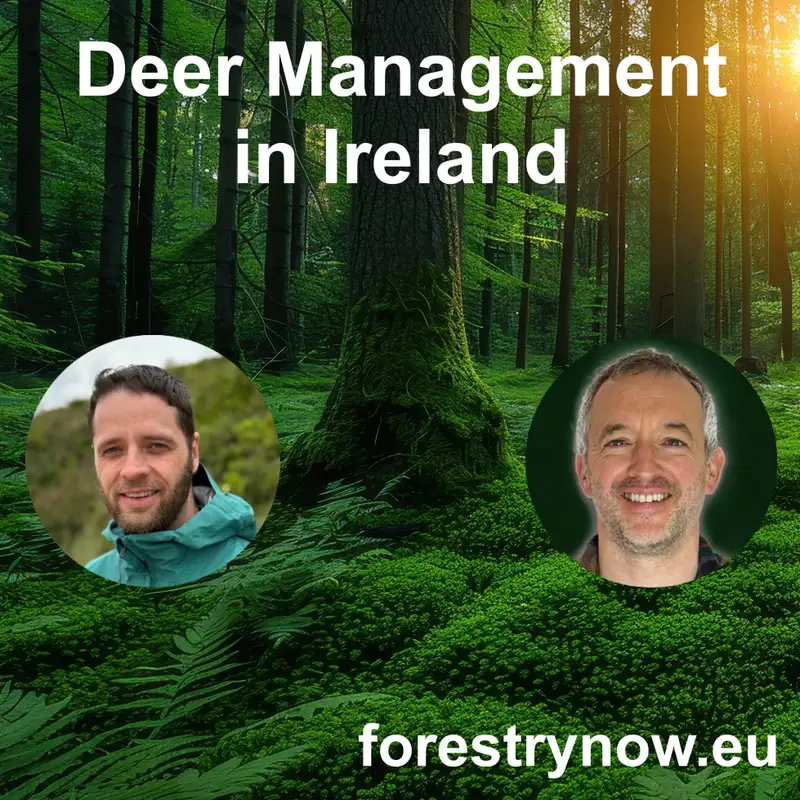
Deer Management in Ireland with Seppi Höna
Download MP3speaker-0 (00:01.784)
Welcome to Forestry Now, where we explore the forces impacting profitable and sustainable management of commercial forests and natural woodlands. I'm Dermot McNally. Today I speak with Regional Forest Inspector Sepi Hona about national efforts to address biraling deer numbers in Ireland. We discuss the problems deer create in forestry and also what the scale of the problem is. Sepi explains how a national strategy group is providing direction for deer management units, which are now operational.
Across the Republic of Ireland. We chat about whether we need more incentives to cul deer, about ethical and operational considerations relating to cul deer being left on the hill, as opposed to being recovered for venison. Finally, there are supports for deer protection in new forests, so we discuss these and other strategies forest owners can take to protect their trees. So without further ado, let's get stuck in. Welcome, Steppy, thanks a million for joining me.
speaker-1 (01:01.046)
Thanks for having me there. Thanks.
speaker-0 (01:02.518)
No problem. Maybe you'd introduce yourself, explain your general role as forest inspector, please.
speaker-1 (01:08.27)
Yeah, so so my background, I'm I went to UCD to study forestry about many moons ago at the stage to and I got gained an honors degree there. After that I went to Aberdeen and I'd done a master's in forestry, just a taught masters with a with a with a dissertation at the end. And then I suppose with my interest in wildlife management, I went to the University of Reading and I pursued another Master of Science degree in wildlife management and conservation. That's really where I tried to tie the whole forestry.
And I suppose deer thing together, you know. So that's really my my my academic background. I s I worked as a forestry consultant for a couple of years and my after college and my formative years and and and my career, you know, doing all kinds of forest management from establishment managing commercial forests or pension funds, estate management, native woodlands. So I was very fortunate to get a a diverse range of of experience there and and and my early years of my career. So
You know, on about eleven years ago I joined the department as a district inspector and now I'm a regional inspector covering the northern region, covering from North Temperary up to Donegal. So quite a a large area to cover, you know. Yeah.
speaker-0 (02:17.336)
That sure is. That's a that's a big swipe. Okay. So tell me then, before we move on to talk about the deer management approach that's happening in Ireland, maybe we'd step one step back and you'll explain what you're seeing on the ground in terms of the way deer are actually affecting forestry at min at the minute in Ireland.
speaker-1 (02:35.574)
Yeah, so we know, you know, from our national forest inventory dermitt, we do a national forest inventory every five years. And my colleagues in forest sector development take the lead on that in conjunction with with f with forestry inspectors that are taken on to do the work. What we basically do every five years, we've over we've around two thousand sample points, forest slash woodland sample points, where we collect forestry-related environmental data, be it the clear, you know, to assess the
the quality and the extent of forestry and and and woodland cover in Ireland. And as part of that, we take we, you know, we assess damage levels for various things, biotic factors like, you know, like diseases, like domestic stock impacts, but also we we assess damage levels from deer, which is very interesting. And we know, for example, that in 2022, which was when the last cycle of the NFA was completed, that 36% of sample plots had some level of deer damage. And the previous cycle in 2017,
We had considerably less. So we know there's a negative trajectory there, even from our national inventory. But we know from our own experience on the ground, we have inspectors carrying out inspections on a on a daily basis around the country. And we just know that the extent and range of deer damage has increased significantly over the last couple of years based on the the the schemes that we have to inspect. A lot of schemes relate to, you know, like the the correct and and successful establishment of trees at appropriate stocking levels. And we can assess from that then.
You know, you know, what levels of damage there are. So we know from that from from that work too that damage levels and and spread of deer is increasing derming, you know. And next
speaker-0 (04:09.462)
The next question is there is a perception that deer are only eating broadleaf trees. Is that correct? Or do we have evidence of damage to conifer crop?
speaker-1 (04:18.6)
Deer can can damage all types of trees if they're if they're at sufficient high levels and even unpalatable species like setya spruce, for example. Like, you know, we would distinguish when you're looking at deer and and browser impacts, you look at shrub or tree species, are they palatable or unpalatable to the to the deer per se, you know? And setya, because of the needles, the the chemical composition, it'd be seen as quite, you know, unpalatable for deer compared to, for example, oak or birch or roan, for example.
But we also have conifer species like our native Scots pine, Douglas fir, western red cedar, species that we're trying to get integrate more into our forestry programs and our schemes from a diversification point of view, for example, in the CCF scheme, those species are incredibly palatable to deer. So they're obviously that's obviously a complication that we need to look at when we're looking at our schemes and ensuring that forest owners and foresters are aware of those risks when they're planting and planning for those dermat, you
speaker-0 (05:13.024)
And again, just set in the background, are the deer affecting only new plantations where the trees are young, or are they an issue for established woodlands? You mentioned continuous curve forestry. Maybe you just explain for anyone who's not thinking this way how deer are affecting all types of forests.
speaker-1 (05:28.736)
So deer can affect forests and woodland habitats at various stages of development, be it when the the trees are young and regenerating, for example, in a native woodland or a continuous cover forestry system, where you're relying primarily on natural regeneration to as your your primary growing stock per se, you know. But also when the trees are are older or at ticket or or pre-ticked stages, we might call them the trees are maybe six or ten foot high, deer can come in.
Fraying, for example, during the rotting season where they mark their territory. Bark stripping can be a big problem, especially in hard winters and fairly inhospitable environments. Deer can can bark strip. Sometimes there's a lot of you know versions why deer do that, for example. Could be nutrient deficiencies within their normal you know, feeding habits, for example. But also, you know, it might be a territorial thing. But bark stripping obviously
you know, is also quite problematic from an economic point of view. If your objective is to grow good quality timber, bark stripping in years to come concrete to butthrot, for example, and a a reduction in quality of your merchant of a log. So they're all all those things come together, Dermot, at various stages, be it, you know, your CCF where you really need your regeneration to come. But I think what's also important, we're talking, you know, there's a lot of talk about climate change, you know, diversification.
bringing more resilience into our forest estate. And we obviously have our woodland improvement scheme where people can can convert their their their even aged forest to continuous cover forestry. And obviously a part of that is to bring more diverse species into your stand of maybe pure Setya spruce or Norway spruce. And a lot of those species are in front are are are unfortunately quite palatable, as I mentioned earlier. So we need to be aware of those things. And yeah, so that's really it in relation to you know impacts and in relation to various stages of of forest development.
speaker-0 (07:17.486)
We will move on to how we're planning and managing and calling deer numbers. But before we do that, are there groups or individuals who don't want deer numbers to be reduced or is there people that want deer numbers to stay high for some reason?
speaker-1 (07:33.614)
Well, I think to be fair, Dermot, I think most responsible stakeholders want deer to be at sustainable levels. even from an an animal welfare perspective, you know, due to lack of we don't have any natural predators for wild deer in Ireland. So it's essential to cull deer to keep them at a a healthy balance, you know, from a population point of view, but also between the population and the environment that they affect, you know. So I think in fairness, most stakeholders I think understand that deer at
High numbers are having an impact, you know, on on the environment, but also on the herd itself, you know. And listen, obviously hunters, I'm a hunter myself for twenty two years. You know, I started hunting deer when I was when I was a young guy going out with my family. I can attest to it's nice to go out when you're hunting to sea deer. But that can also that can work absolutely in tandem with with with sustainable populations. And having sustainable populations, you can still see, you know, you know, you know, good numbers of deer if if the conditions are right. So
I think in fairness, most stakeholders are quite reasonable and understand that that that balanced populations are an integral part of land management and and a healthy wider environment, you know? Yeah.
speaker-0 (08:40.096)
And just on that, I mean, is there evidence that deer numbers okay, they're creating impacts on forestry and farming, but are the deer numbers so high that there's unhealthy deer within the that's out there or is that something you you're able to assess?
speaker-1 (08:55.598)
Well, like from my own personal experience, you know, and I've hunted quite a couple of counties in Ireland over the last twenty two years. It's rare now that I've come across unhealthy deer. I have shot deer with tuberculosis, for example, which can have various you know, come can come from various reasons, but generally because of our climate, the climatic conditions and the environment that our deer live in. It's very good to deer, I g if I could say so. You know, you know, we have some fairly inhospitable upland areas. They might be the exception, but generally
Ireland is a is a very good habitat for deer, you know. We've we've a lot of grass growth, we've good vegetation growth, excellent tree growth, as you know, Dermot. So that kinda works in the favour of the deer. But what I'm saying in relation to a healthy deer population, if it gets to a certain extent and gets high, you know, we do know from population ecology, for example, and and you know, scientific research that it can affect the health of the overall herd, you know, but and breeding and maybe other diseases that might develop. So it's just good practice to keep the
populations at a good at at a healthy level, you know?
speaker-0 (09:56.47)
And just at on the population numbers, do we do we actually know how many deer are in Ireland or how do we estimate the numbers apart from obviously witnessing the damage?
speaker-1 (10:07.458)
Yeah, so to answer your question, we don't know how many and how many deer are in Ireland. It's impossible to count deer at a country level, never mind at a landscape level. It's very, very complicated. There are, you know, methods out there. For example, the the development of infrared technology, drone technology is becoming quite popular over the last couple of years, especially in conjunction with machine learning. AI, for example, which is able to identify the different sexes and the different species. Now, again, infrared.
technology and drones, as you might know, has its limitations. It can't look, as I say, through the canopy of a forest. A lot of our deer use forests at certain times and many times of the day. So that's quite complicated. Weather plays a role in it now. There are other methods you can use, for example, camera trapping. There's a lot of research going on, for example, putting up camera traps at certain intervals. And you know, that's an opportunity there to to to count deer also. And also in the past there's been things like fecal pellet counts where you can estimate
But a lot of that's quite subjective, Dermot. So that's why I suppose from a international best practice point of view, the best guiding principle for assessing if your deer are at acceptable and and and sustainable levels is assess the vegetation, assess the woodland habitats, assess your habitats of conservation value, and that will tell you then, am I at a good place in relation to my call figures? Do I need to increase them? Can I maintain them? That sort of stuff. So it's international best practice and it's acknowledged.
Counting is quite subjective at a larger scale, certainly, you know.
speaker-0 (11:36.504)
Perfect. I've obviously seen it myself and huge number of deer in Sligo and and other parts of Leitrim and they're very common. So we do have a deer problem and it's challenging for individual forest owners. And I suppose for a decade or more we probably had people calling for a national strategy and that has now happened. You're part of the Irish deer management strategy group. Maybe you'd tell us who else is on that and what the strategy group hopes to achieve.
speaker-1 (12:03.49)
Yeah, so the the Irish Deer Management Strategy Group was was set up by our then Minister, Charlie McConnell in September twenty twenty two under the the chairmanship of of Teddy Cashman. And Teddy is as is supported in this endeavour by three representatives from the Department of Agriculture. There's myself and two colleagues on the veterinary side, three members from National Parks and Wildlife Service and a representative from Queelshi, being the largest forest owner in the country.
And I suppose the strategy we we met earlier on and we we we said, listen, we have to come up with a couple of recommendations here. And in fairness, in the early stages, Teddy to his credit elevated the levels of engagement with with stakeholders in particular, just to get people around the table, you know, to hear people's views. Because this was a key thing, you know, on any of these kind of landscape land use kind of issues, you know, at landscape level, communication's often the big issue, you know, people aren't talking to one another. And in fairness to Teddy, he pulled everyone together.
And, you know, especially the people from the farming community and the land use community to foresters, ENGOs, for example, hunters too, to, you know, to to get that together and get the voices, voices heard. And I suppose following on from that then in December 2022, we launched a public survey in relation to to de you know to the the development of a national deer management strategy, you know, like what did what were people's views on it? What did people feel were the main issues?
What did people think and feel were, you know, the main opportunities in relation to deer management to get deer to the sustainable levels in various parts? So that was a very good exercise because I think we don't we we'd a lot of respondents and that gave us a good idea and flavor. Well, what are what are what are people thinking here? What are people thinking? Are the challenges? Like one thing I think is really what really stood out to us was, you know, we basically one of the questions we asked was what are the main impacts of increased deer numbers, for example, you know, and the number one
The highest I suppose issue that was raised was biodiversity loss and damage, you know. And you know, I think that's quite interesting. I think, especially now the whole discussion with with climate change and with the nature restoration law. And I think generally dermitt people are becoming more aware of the environment, you know. We thought there would be a lot more pushback, for example, on you know, deer culling as a measure, but absolutely not. Eighty-six percent of people
speaker-1 (14:25.52)
that responded said that deer culling was the the most important option to deal with this problem, this biodiversity issue you could say, you know. So we gained a lot of interesting kind of facts from that. And I suppose following on from that, we had a public meeting and in Port Leash, following on from the survey to present the survey to stakeholders and everyone was invited. This is an open forum. Anyone could attend, you know, you didn't need to register. And then P we presented it and people were able to give their views and their feedback.
And I suppose what followed on from that then, which was quite important, was we set up five subgroups. So we had the survey, we kind of had a flavor of what people were thinking and kind of suggestions people, you know, had in relation to the the the overall issue. And we said, right, we need to try and get something on paper. So how do we best do that? So we created five subgroups, you know, relating to the main issues like land management legislation, venison, for example, was one of the things. So there were five subgroups that were chaired. I shared the land management one.
And we basically we had a number of meetings. again, every stakeholder was represented at the various subgroups. And from those subgroups, we developed a report. And that report was published in I think September 2023 by our then minister for agriculture, Charlie McConlog and his colleague in the Department of Housing. And that really put, you know, I suppose short, medium, and long term recommendations on paper.
It was a a government adopted document that really charted the way forward on how we you could really say as a strategy group would deliver and try and deliver measures and policies that would improve and sustainable deer management in Ireland. So that's really where we went at that stage. And then obviously one of the first things we done was we reviewed the open season order and we changed the open seasons order, and we brought it in line with the with Northern Ireland that's currently going to be reviewed again.
So we're going to review that more regularly to see how it's doing. You know, are there are there tweaks that we could make to it to make it more effective? But then also one of the big things that came out of it was was the development of a deer management project that farmerly services were were were awarded back last year. So that's really where we were at, stermint in relation to the background and where we're at with the strategy group, you know?
speaker-0 (16:36.866)
Yeah, before we talk about the deer management units themselves, what do you mean by the the open season? What what happened there?
speaker-1 (16:45.004)
Yeah, so the open season order was you know, we changed the we extended the open season for the regular hunting season for deer. So we extended it for both males and females. And we brought it in line with Northern Ireland. So previously, for example, the the hunting season for males opened in September, and now it's opens in August. And for example, it opened for it ended for females, you know, in February.
But now it's it ended in March for females, for example, and it ends in April for for males. So they're all kind of things that we can in in the short term we initiated and and and brought in line, you know, with with in the the first instance with Northern Ireland.
speaker-0 (17:23.821)
And obviously that gives more opportunity for practical culling, you're just making the window longer in the year.
speaker-1 (17:29.464)
So Yeah, so that's for the the regular hunting season. The other option that landowners and hunters have is what's called a section forty two. So that is basically an out of season license that's that's administered by the National Parks and Wildlife Service. For example, if you can show that you have cr crop damage, for example, or damage into your forestry, you can apply for an out of season license and that allows you then based on the license to cull deer out of the regular hunting season. That's another you could say tool that we have in the toolbox, you know.
speaker-0 (17:56.75)
Okay, that's good to know. Wasn't aware of that. Okay, so tell me then about the the deer management units and the role FRS play in implementing that, those units.
speaker-1 (18:07.874)
Yeah, so FRS were awarded the contract to deliver 15 deer management units around the country, led by a dedicated project manager. so that contract was awarded last early last year, and those deer deer management units are basically being managed by a core group of deer management coordinators. They're located around the country. Donegal, Mayo, Ross Common, Galway, down in the south, Wetlow, for example. So there's I'm not sure, I think there's eight or nine.
coordinators around the country. And their job basically is to to set up deer management groups and units and to coordinate between landowners so that deer can be culled at more effective and efficient levels, basically. Landscape level deer management, because managing deers, you know, dermot at at a farm level or a forest level is important. That's one of the reasons why we developed this project to see how can we apply this in an Irish context. You know, deer management units are are quite common.
across the UK, for example, but also in Europe where it's where I suppose in a lot of cases it's ingrained in in law that landowners must participate in a deer management unit, for example. It's not even an option because I always compare deer to whole water quality issue. If I'm a landowner I and I create a water pollution incident, that can have an impact on my my neighbours or my the other members of society downstream, for example. So that what my actions can have an have an impact on other people. And it's the same with deer. If I have a deer problem on my land
And I don't take action, that impact can impact, for example, the neighbouring farmer, the neighbouring forest owner. So it's important that there's a collective approach to deer management and that we can manage deer. So this is what this project's really looking at into to see how can we do that and hopefully can deliver that at at a large scale.
speaker-0 (19:49.77)
And then the coordinators you said there's about roughly nine of them in the country. Are they full time or part time guys and girls?
speaker-1 (19:57.698)
Some of them quite a lot of them are full time and some of them are part time. the exact details I'm not aware of because I suppose that's a matter for farm relief services. But they're a core group of of of very enthusiastic and able individuals, very dedicated to making this project work, I must say. I've met I think nearly all of them. And you know, you know, we wish them the very best of luck. They're making good progress at the minute. So I'm we look forward to further progress, you know. So Yeah.
speaker-0 (20:23.586)
So on a local level we've got a a coordinator of a local area. You you said there's maybe about fifteen areas that have been earmarked and there's a coordinator who's who's managing each area. What does their day to day role look like then? Are they the ones that are calling or are they mostly in a coordination and surveying role?
speaker-1 (20:45.902)
Core project is about facilitating and coordinating between landowners. Their part of their project is not to cull deer. That's definitely not the case. Their their role is to collect interested landowners, bring them together, agree a strategy on reducing deer levels in that unit or you know, between those landowners, landowners, and to have a platform of of communication, collaboration, and listen, just to see how it works, you know, that this project.
This is the first kind of project, you know, of such a kind in Ireland. So, you know, we will look at this and we'll see, listen, what do what are we doing? How have we done it? Are there improvements we can make? 'Cause as I said, it's not been done before. And we just really have to s wait and see how it works out and to see what the results you know, are the results of sufficient quality that we could say this is actually worth continuing doing. But, you know, listen the by all by all accounts the progress is quite good up to date, you know.
speaker-0 (21:38.838)
And then there maybe pulling local groups together. Do we have enough hunters out there? That's I suppose the next question to actually do the culling if we see there's a a need.
speaker-1 (21:50.584)
Well, I think I'm not a hundred percent sure how many hunters there are at the moment. The one thing I do know, the number keeps keeps rising every year. So the number of hunters is I think it's five or six thousand dermitt. That could be anyone from shooting one deer to hundreds of deer. You know, so a lot of hunters, you know, based on their personal s situation, I know from my own situation when you've children and you have a job and you have other things going on, you might even do a lot of culling. So that completely depends on on the availability of those hunters. But what I would say is
You know, even though FRS isn't directly contracted by the department to actually carry out culling. If landowners or forest owners are having issues with getting a deer hunter or a hunter on their land to cull deer, I've no I don't think there'll be an issue with the with the coordinators, you know, providing interested landowners or contact details of hunters who might be able to help them. So I think that's fair enough. Like if people have a problem, they should reach out to FRS and and and contact their local coordinator. That that's absolutely fine. So yeah.
speaker-0 (22:47.384)
Just I read in a press recently, if I'm right, that several large venison storage units have been bought and placed throughout the country. Am I right in that and and was that funded through the same project?
speaker-1 (22:58.914)
Yeah, so the Department of Agriculture, you're correct. They we've funded the purchase of a number of chilling units, and they've been placed around a number of locations around the country. Ross Common, Wecklow, I think there's one or two in the south. And yeah, so so they're they're they're strategically located around the country. The exact details and locations of them, Dermot, I'm not a hundred percent sure, but think there's four or five. And I suppose the whole idea of of
The department funding those and and farm relief services are going to manage that process as part of the project, as really to you know, one of the issues that we found was there are only about five registered game handling facilities in Ireland. I, you know, basically larger is you know, establishments that can buy in large quantities of in for a while game. And there's only about five around the country. And what we've really found, well, we know from personal experience, but also as part of the, I suppose, the the engagements we've had with stakeholders is.
quite difficult for a lot of hunters to access those five game handling facilities based on where you're where you're located, for example. And then a lot of hunters mightn't have chilling facilities at home of a sufficient size to cull large numbers of deer. So I think we came up with a pretty good proposal. Listen, let's fund, you know, the purchase of a number of these larger chiller units that could hold 50 to 60 animals. And it provides hunters in those areas with a another, I suppose, you know, avenue to bring
larger numbers of deer and then a registered game handling facility can come to those center locations and collect in addition to collecting deer on their own behalf or hunters bringing them to their own facility. So again, what we're trying to do is increase capacity here, increase opportunities for hunters to encourage hunters to shoot more deer, you know. So that's really that's really the background to it, you know.
speaker-0 (24:45.122)
Yeah, an anecdote I have on that is one hunter I know, he told me that and it's strange, you know, the observations people who are in the countryside, land managers, farmers have. His observation as a hunter was that in times gone past, when he started hunting, he could hang the deer in his own sheds and it was cold enough in the winter that you were predicted that you you get a couple of cold days where you you could comfortably hang a deer. Whereas that's not happening now with climate change. We're we're seeing higher higher temperatures over
The winter. So he said to me, W have you any experience of that, Seppi, or does that ring true?
speaker-1 (25:19.97)
Well, it's definitely supposed listen, that depends on on the hunter, but some hunters mightn't have any chilling facilities. You know, some hunters have have walking larger, so you could nearly say, Well, you can hang maybe ten or twenty deer. Others might have just have a coke fridge, for example, where you you'd be lucky to hang two fallow deer. So it depends on the hunter. For example I seen, for example, recently in Scotland, which I thought was really good, they've actually developed an incentive or fifty percent of the cost towards a simple chilling unit.
has been made available to hunters. So that's might might be something that we look at down the years too, you know, from from a strategic point of view. So there's there's a lot of things you can do. It's all really about increasing capacity, making it easier for hunters to shoot more deer. And that's really been a problem in Ireland because quite often, you know, we know traditionally, for example, you know, up to Christmas, game dealer prices are quite good, you know, we could say, just roughly speaking. But after Christmas, they can fall off quite quickly. And that's a disincentive for a hunter.
And then if you add that situation in that mightn't have enough chilling facilities, et cetera, a lot of people then just stop shooting. And that's what we really want to we really want to look at that. Well, how can we deal with that? How can we keep you know, call numbers up post Christmas and right into the winter and into spring so that we can get our numbers down nationally, you know?
speaker-0 (26:36.172)
Yeah. Yeah, I know I'm I'm aware of guys. And once the larder's full at home, that's it. The gun goes away. So and another thing, has it come up at the strategy group that we need you've mentioned a couple of incentives and a couple of supports you're already putting in place. But is there any talk of an actual incentive for calling more deer itself, like a you know, a price per head or whatever that that way might work?
speaker-1 (26:58.53)
Yeah, so that's something that we're currently, yes, correct. We are looking, you know, we do acknowledge in the strategy group that more deer need to be called. More of the right deer, I would say, Dermot, you know. with right deer, I mean more females and juveniles. So what we're currently working on is an incentive to incentivize hunters to shoot females and juvenile deer, to get them off the ground, you know, and an from from an incentive point of view, that we basically if you bring a hind or a doe and a yearling or a calf to the game, they'll really get a set
price per per per animal, you know. And that's then obviously on top of what you might accrue from from the game dealer who'll also pay obviously at some some point. Now that that there's two elements to that really number one is as I said earlier to incentivize people to shoot more of these types of deer right through the season but also as I said to deal with some of the the shortcomings with the with the with the venison prices that the the registered game handling facilities traditionally pay less after Christmas, for example. So that's the we're trying to bridge a bit of a gap there.
to keep the interests going for the hunter, to keep the cult. They they've done similar things in Scotland over the last two or three years, and by all accounts it's quite successful from what we've heard from our colleagues in Nature Scott, for example, so it's been quite effective. So we're gonna trial something here too, over the next couple of months, you know.
speaker-0 (28:13.506)
Yeah, that's very good. Okay. So in other words, if you manage to to to remove a a female, you're effectively knocking you're removing her out of the equation and a number of new deer that she might give birth to. So yeah, that makes sense. Is there any risk that we're gonna call too many deer or that we might go too far with all of this?
speaker-1 (28:33.9)
No, I don't think I don't think in any of the tempered regions where they've at times very elaborate wildlife management strategies, have there or will there ever be a situation where you c cull too many deer? As I said earlier, derm derm deer are doing very well in Ireland and the whole tempered regions across Europe and North America, deer are doing very well. Climate change has actually, you know, created improved conditions for them to reproduce and to to you know, to find habitats. Listen, we've
As you know, we've you know, we have increasing forest cover too with our various afforestation schemes, maybe not as much as we would like every year, but our forest cover is increasing from maybe a from a from a base point from the in in the early nineteen hundreds. So that has created additional habitats for deer also, you know. So that's helped them along the way too. So I I don't think and I don't think anyone will probably disagree with me. I don't think we'll ever get to a stage where you shoot too many deer, you know, because I think what's really important is, you know.
We have to keep the landowner in mind here, be it a farmer or a forest owner. And, you know, if the deer are occupying their land, you know, you could say it's their problem. And if they're impacting their objectives, then I would say there is a problem. And I think, you know, I think any responsible hunter would agree that if, you know, if you're a guest on someone's land or you're even paying for someone to hunt on their land and the deer are impacting their objectives, it's only right that you do everything you can to
To address those issues and go shortcomings and call the appropriate number of deer that you're required to, you know. So yeah, I think that's really it, you know.
speaker-0 (29:59.426)
Yeah, okay. Are we a culture of I suppose of of deer hunting that might be more common in Europe? Is there an element there that we need to work on?
speaker-1 (30:08.238)
Yeah, I wouldn't say we've got a like yeah. the hunting culture is quite developed in in Europe for many hundreds of years. It's not an Ireland as of yet, I would say, but it's developing a lot. We you know, just take for example, twenty years ago, Dermot, you could go and you could apply if you had a hundred acres of land with deer on it, you could apply for a deer hunting license. And you could go to your local garden station and your firearms dealer and you would get a license and a gun. Pretty easy now to to hunt deer. Now
If I if you, for example, got into deer hunting or wanted to get into deer hunting, you would have to do a mandatory deer hunting course. There are about three of them, I think, in the country. Now, that was a that was a long time coming, you know, because previously you could get into deer hunting, carry a high powered firearm onto firearm land with very little without having to show any level of confidence for the other than that that you had access to, I think, to a hundred acres of land with deer on it. So we've come a long way there. And that really came from, I would definitely argue from
from the continent and from from abroad, where that was always a requirement that lesson you had to, you know, show a level of competence when you're taking a firearm out. You're, you know, you're doing work in the environment, you're shooting wild animals, you know, there's kinda there's issues around that too. So but you you know, you have to show some you always had to show some level of competence. So we've come a long way there. So that's kind of, you know, we're kind of slowly moving in the right direction. But you know, the traditions that they have in s in Europe, you couldn't compare them with here. Like for example, a lot of the
The things that we're doing on a voluntary basis there, but they're they're ingrained in law, for example, there. You know, just say, for example, if I'm a if I'm a forest o if I'm a hunter, for example, in Germany and I I, you know, lease a forest, for example, because of my hunting, there's increased browsing pressure. I have to pay the forest owner damages, basically, you know, and that's that's been quite developed for for decades there, you know, and it's it's similar in other European countries. So as hunters, we're quite lucky in Ireland, I would say still.
You can still go on to a farmer and ask him, Listen, do you mind if I shoot deer in your land? And most people are are quite happy to allow you onto their property if you show them your your your insurance and your hunting licence. So landowners, including forest owners, are I think are very obliging to hunters and and so it's great to see that, that collaboration, you know, but it's it's quite different in Europe now, you know.
speaker-0 (32:18.478)
This podcast is kindly supported by the Irish Department of Agriculture, Food and the Marine. If you're thinking of planting a new forest or keen to access information on financial and technical supports to manage your existing forest, then go to gov.ie forward slash forestry for you. I'll include that link and other critical details about the guest and this topic in the show notes. Now, back to the chat.
I know we hadn't in our pre discussion here we hadn't talked about this, but Sepi, like if I said to you in the morning, Gino, I really wanna get into this, I wanna buy a medium a medium spec rifle and I wanna do the training, I mean, w what kind of time and money is it gonna cost me to get up and running for the winter season? Or is that realistic?
speaker-1 (33:06.582)
It's probably as it depends. the the the biggest, I suppose the first thing you'd need to do is do the one of the three accredited hunting courses. Then you need to apply for your hunting license through the National Parks and Wildlife Service, and probably in tandem, you need to apply for a rifle license to a fi a registered firearms dealer, which there are a number of around the country. So and quite often the delay could be what the the authorities and the and and processing your firearms application.
But in fairness, there's been huge improvements there also. In my experience, like I as I said, I've been hunting deer for twenty-two years. You know, it used to be quite an arduous process, long, you know, took a long time. But in fairness, the authorities, including the the the Guardian and National Parks, have become very efficient at developing, you know, their systems and progressing applications quite efficiently. I think about two years ago, the deer hunting license was was application was moved online, which is excellent. I know from my own personal experience, a very simple system.
And a couple of minutes of your application, especially if it's a renewal your application has done, which you have to do every year. so that's very that's that's excellent. So there've been big improvements there too, Derm, to make to make the whole thing more more efficient for everyone involved.
speaker-0 (34:13.656)
There was some newspaper coverage that the National Parks and Wildlife Service were culling deer, of course, but that they were leaving them in situ on the hill as opposed to having the carcasses removed for venison. Can we talk about that a little bit, the pros and cons and whether or not it's an ethical approach to managing the deer? Because not only on national parks and wildlife land, but in a lot of forestry especially, it can be
quite difficult to to get access on a site that has been remounded or replanted in forestry. There's quite often not great trails or pathways through it.
speaker-1 (34:50.796)
Yeah, so I'm aware, I am aware, as you just said, that that this is a practice, that this is a practice being conducted in a number of our national parks. I personally I would have have concerns about that from an ethical point of view, primarily. And secondly, I suppose one of the concerns I would have is that there was no research conducted prior to this practice commencing. Like the only research that I'm aware of that has been conducted in relation to this was in a completely different geographic.
location in the world to I suppose Ireland or or Europe. But really the real issue for me is ethical. Now I can see absolutely a place for this. If you're in an in a very remote area, Dermot, and you have shown that there's significant numbers of deer there that are significantly damaging a habitat and that an accessible place, then I absolutely accept you might have to cull deer there and leave them and sit you. That's completely acceptable. But I do have an issue
If it's the case that deer are being shot close to access tracks from an ethical point of view and they're being left there because the deer can easily be brought to a coal store and brought into there to the the food chain. The ecological benefits, I don't know, again, in my view, that's just my personal view, the research should have been conducted first because there could be significant unintended consequences here. For example, an increased number of ra of predators, for example. You know, what are what what are the impacts on water quality potential?
And you know, the resource argument, it's d an absolutely the easy part in hunting is pulling the trigger. The most difficult and time and cut time timely part is r the removal of the carcass from from the forest or the field or the or the mountain. I fully accept that. But listen, gamekeepers across Scotland, we like reference in Scotland and even Europe, they regularly it's it's well known, call a hundred and fifty, two hundred deer themselves every year and extract them.
And in a lot of cases that I'm aware of, we're not talking about a fraction of these numbers. So the resource argument doesn't really stand for me. And I would question the ecological benefits, but I do know a research project has been initiated to look at the the benefits and challenges of this. But again, I would put in the caveat, this research has been carried out a number of years after this practice was initiated. So I suppose all we can do is wait and see the results of that research, you know.
speaker-0 (37:07.542)
Yeah, so there's obviously yeah, the loss of the potential venison to the market. How is that venison market actually? Or I mean, I've I've I've eaten venison myself. I I like to support people that are supporting the forestry industry. But is there anything happening from the strategy group on that? Or is there any way you can help influence culture here in Ireland that we eat more deer?
speaker-1 (37:30.582)
Yeah, that's a very good question. And, you know, I suppose a lot of people refer, you know, when they when you talk about venison as a food source, it's seen as something you fancy, you only get at the restaurant. You know, but venison, you know, we need to make venison more popular, Dermot, because, you know, as they said and I think it was Australia many years ago, you know, where they had problem with with invasive deer. Beat yourself out of the problem, you know. and it really does that it really is true. Like it's a hugely nutritious red red meat.
High in nutrients, high in iron, extremely low in fat compared to compared to beef, for example. So it's in it's incredibly nutritious. And yes, we are looking at venison, the venison market, you know, as part of the strategy group and as part of the recommendations in the 2023 report. It is a thing that we have to continuously look at. I know farm relief services are doing some very good market research on on the market of venison. And you know, hopefully we can see venison that's shot locally.
sold locally. For example, we have, for example, an EU regulation that hasn't been brought into force in Ireland. Where I'm a if I'm a trained hunter, for example, in Europe, you know, you do a you do a trained hunter, what's called a trained hunter course, whereby you can, you know, once the animal is called, you can you can do a a very high level examination of the animal to make sure that it's healthy for human consumption. And if I've done that trained hunter course and I've I've looked at the animal and said this is fine, I can sell venison shot locally on on mainland and the continent in Europe.
Within 70, I think a hundred kilometres of where I live. So I don't need to go to to an abattoir or something. If I've got basic fuss you know, hygienic facilities at home, I can process and market and sell my venison locally. So we're not at that stage yet in Ireland, but it's a place I'd really like us to to be at some stage because this is the key. When you look at climate change and, you know, general, you know, I suppose behaviour, I would say, you know, it's kind of
I think a lot of people would really like that idea, which is this deer, this I'm eating Venice that was shot in my neighbouring townland and you know it's it's gonna improve by it's by by culling deer, it's gonna improve biodiversity and it's gonna, you know, increase our native woodlands. there's a good story here that we can leverage, I think, Dermoton, you know, by also providing healthy nutrition to our population, but also there's a good story behind it too, and you know, in relation to to to to biodiversity and, you know, everything that's going on with nature and climate change, you know.
speaker-0 (39:54.638)
Yeah, no, absolutely. Well it sounds fantastic, Sepi, that yeah, we might move to a place where a local hunter could sell venison directly himself because am I right in saying at the minute the the hunter can't but he can consume himself for his or her family. The he can use it for personal use. Is that the situation?
speaker-1 (40:12.974)
Yeah, there's no yeah, absolutely. So a hunter who shoots his own deer can bring them home and you know, bone out the animals and and and do his own thing. Absolutely. Like so there's no there's no, I think, oversight there required because it's for your own consumption, you know. But if you want to obviously and and it's absolutely I think it's important to note we do need controls or we don't want a situation developing as we're where where meat is is brought into the food chain that, you know, can can cause a health issue for our population. So by all means this
anything to do with this has to be well thought out with the various you know, authorities involved and and buying in and feeding into the process. So we do need to get this to a stage, but it has to be done right and and cognizant of the fact that we have very tight and and and good food safety standards and they must be maintained dermitt, you know. So that that's that's important to know too, you know.
speaker-0 (40:59.628)
Yeah, no, you're you're a hundred percent right. It isn't enough. When the money incentive is there, it it brings with it a different element. So yeah, no, it makes perfect sense that it be an option that a trained hunter can go on and get certified to be able to sell to market. And as you say, it just needs to be done right and in such a way that it isn't too onerous to get that certification and that it it's it's accessible. Because I think, you know, at times in Ireland, what we hear across the board is
that an awful lot of what we do in terms of regulating and certifying all is is all motivated by the right incentive, but it sometimes ends up being overly burdensome on the people who who want to, you know, do whatever it is is being certified. So yeah, that I think that's the
speaker-1 (41:45.268)
You want any policy to be conducive to get the thing being done and you know, there'd be a an increased uptake. But I think it's important to say also that's just one tool in the toolbox. We obviously need the the game handling facilities with sufficient capacity to take those larger numbers. Because let's be honest, like I think officially I think was there seventy or eighty thousand deer shot in the last hunting season. Obviously people, you know, can't eat those themselves. So there has to be a an industry there that that can take the larger volumes and
you know, to provide a market for hunters to to to get good value for those in and those situations too, you know.
speaker-0 (42:19.286)
Yeah. Another thing that occurs to me, and if if I'm catching you off, don't worry about it, but we have non native deer species here. I'm hearing about munchak and and certain deer that maybe weren't as common years ago and certainly aren't native. Are they protected fully under law the same way as other deer, or should we be making an effort to eradicate certain species, or has it gone past that point?
speaker-1 (42:41.592)
Yeah, so I know for example that at Seekadier now, I think last year was was was was signed an invasive species status by the European Commission. Now it's up to each individual country then to develop, you know, regulations to enforce that EU directive, you know, and it really does it's it's not been decided from what I know what how the Irish authorities are going to deal with that. But at the minute all deer are protected. You mentioned Munchak, for example, Dermot, there there've been anecdotal, you know, sightings of Munchak over the last couple of years around.
The island of Ireland. I've never seen them. my understanding would be like based on what I know about Munchek, if we did have Munchak here for the last number of years, we should have large numbers of them. Because compared to you could say sea calf, fallow, and red deer, Munchak can have young deer a number of times a year. So they're not just, you know, they don't just become they come and heat once a year. So they can do it multiple times a year. So
I would have thought if we had munchek there'd be a lot a lot of them around. But listen, there's anecdotal evidence on there they they have an open season. you know, people are encouraged to cull them if they see them. But I think to you know, to to answer I suppose that the you raised the thing about eradication. It's impossible to eradicate wild animals, I would say in general. You c you see it, for example, you know, New Zealand's a prime example where a lot of invasive you know, for example, the fox, the possum, various deer species were brought to New Zealand back hundred to two hundred years ago.
been impossible for the New Zealand authorities to to eradicate those species and it's they've tried very radical methods. So let's bring it back to basics. Let's get a strategy together. Let's get, you know, get landowners working together. And let's try and get deer to sustainable levels. And, you know, deer can live in in unison in in the environment if they're at sustainable levels. They're not causing over overly on damage to crops, to agriculture land, to forests, you know.
You know, then there's no issue with having them. They're integral part of the environment. I think we just need to learn to live with them and obviously manage them at to to sustainable levels where required, Dermot, you
speaker-0 (44:38.498)
Yeah, perfect. Zeppi, I'm about to plant my new broadleaf forest. It's a native woodland. What protection is within the schemes for my trees in terms of deer deer prevention or protection?
speaker-1 (44:51.714)
As part of the if the foresty schemes, we have a number of measures that current or newer prospective forest owners can avail of. For example, we have if you, as you said, want to plant an area of broadleafs, we have a deer fencing grant and where people can apply for a deer fencing grant, but also we have what we've called the deer tree shelter scheme, where forest owners can apply to to get grant aid towards the erection of protective deer tubes and the posts.
and then those trees, those broadleaf trees can be planted in a lower stocking density. But also we've, you know, for example, if you planted two or three years ago and subsequently you establish in the forest, the you know, you start getting deer damage, or for example, hair damage, for example, you can retrofit your forest with a deer fence, or you can put some hair or rabbit wire on to protect your broadleaves. But also then you have, for example, as you as you probably know, Dermot.
If you want to plant conifers, twenty percent of your your site is to be planted with broadleaves. As part of the deer tree shelter scheme, you can also apply to protect those an element of those twenty percent broadleafs to make sure that those twenty percent that area is protected and that the trees can can can grow there, the broadleafs can grow there too successfully, you know. But we have other things too. For example, under the native woodland conservation scheme, I think it's important to point out you can apply for costs towards deer fencing again.
You can apply for costs towards deer tubes if you want to do some under planting in your native woodland conservation scheme. But also if you want to develop a deer management plan with someone. And in certain cases, if you make a a case for it, we can put funding towards the the erection of deer hides, for example, high seats to aid in deer management. So again, that's and that's a constant evolving thing. You know, we're we're always looking at our schemes. How can we make them better? For example, we had our midterm review last year.
we increased the rate, the the the grant rates for deer fencing. We also included deer fencing as an allowable cost towards the climate resilience reforestation that we have, you know. And you know, just making slight changes like that, we also increased the, for example, the area for the deer tree shelter scheme from three hectares to five hectares. So, for example, if you want to plant five hectares of native woodland, FT1 or two, you can apply for the deer tree shelter scheme. Previous to that, you had to apply for a deer fence.
speaker-1 (47:11.352)
For anything over three hectares. So again, we've listened to to stakeholders, we've made some adjustments that we could make just to make it to give more options to forest owners so that could that they can protect their forests in a proactive manner, you know.
speaker-0 (47:23.284)
It sounds to me like if we get a decade of good deer management units and coordination across the country, we could get to a a sweeter place where some of these measures may not feel as urgent because they're absolutely urgent in some locations as as you know, the there's new plantations have been destroyed. So we've talked about a couple of things and let's present one more scenario. I'm a forest owner. I have a a forest that I can see is clearly being
affected by deer browsing at this point. It's not our new forest. So you've mentioned one or two of the options I have. Maybe is there anything else that comes to mind for managing the the deer that are now causing a problem in my semi mature or mature woodland?
speaker-1 (48:07.426)
Well, I would definitely what I would encourage forest owners or you know, landowners in general to do, you know, walk your land, walk your forest regularly, become deer aware. You know, as you just pointed out, Dermot in a lot of cases, certainly with deer, we're we're quite reactive when it comes to measures and and actions in relation to deer. You know, we need to become more proactive. We need to, you know, we need to first of all see the signs of damage. And then I think very important, seek advice if you're unsure, you know, speak to your your forestry consultant.
You know, we've a great resource of Chagas foresty advisors out there, but also absolutely engage with the Farm Relief Services Project here. You know, we that it's it's really as the only show in town at the minute. You know, we've committed a substantial amount of money towards it. We really wanted to work and we want people to reach out to to FRS and their coordinators and and get involved, really. Like, you know, and if you have a problem, the guys there they can help you out, they can give you further advice. But then in conjunction with your forester, for example, you know, and your hunter or whoever.
You can come up with a plan of action. As I said, I'd outlined some of the measures there. Again, you might have to talk to your neighboring landowners, your neighbors to get to get a more landscape level approach. And that's maybe where the DMU project can come in and facilitate that kind of discussion and that collaboration. Even if it's, you know, state agencies like Wheelchair or National Parks you're joining, they're also part of these the the these DMUs where they are. So they they can be a part of that and part of the solution more importantly, you know. So get advice.
Become dear aware and I says become involved in your forest and and and the management of your forest. I think that's something that's been an issue in the past there. But you know, a lot of forest owners would be kinda, you know, quite distance to their forest. They mightn't even visit it very regularly. So I would always encourage people, even in my past experience and and profession, get involved with your forest, look at how your how your plantation is doing. Where's the damage? What work can I do? What do I need to do? That kind of thing, you know.
speaker-0 (49:55.81)
Yeah, no, you're a hundred percent right. And and every conversation I have about practical forestry management just re-emphasizes the need to have access pathways, make sure there's a a a clean way where you can go in. I I did ring up my local DMU and I spoke to the coordinator, told him all about the forest I have and the the problem I'm having with deer. And he was delighted to hear that there was a forest road in place, first of all, where a potential hunter could come pull in and park safely.
And that there's also a quad track in place, an access route that someone can move over through the land and reduce any potential haul distance for for anything that that is shot. And and thirdly, then he asked me to to get in touch with neighbours, as you said, and pass on numbers and in that way take a more coordinated approach. So I that that was all of that was very easy for me. He made it very painless, I I gotta say. So I I I do agree that things are starting to happen on the ground.
speaker-1 (50:51.192)
Yeah. And I think it's really important that we that we support this. And as I said, it's early days, you know, Rome wasn't built in a day, Dermot, you and this is when you're dealing with as you well know, if you're when you're dealing with land and land use and and and and and landowners in particular, people have different objectives, people have different ideas. Maybe they're not fully informed of in relation to deer and how maybe they could be managed better. This is going to be a long process and we can know we're we're gonna learn along the way. We're gonna make mistakes and that's completely okay. The main thing is that we learn from our mistakes.
You know, we regroup, we come up with another strategy, an improved strategy, and keep measuring its success. And it really does have to come back to is this successful? And it really has to come back down to then what are the what are the variables here we're looking at? It has to be habitat assessments, impacts and vegetation. Are there improvements? I referred back to I'll refer back to the NFA, for example. Maybe there's we look at the NFI in years to come. Maybe maybe we have local sample plots where these these deer management units now are in the future will be so that we can constantly
capture data to see how are we doing? Do we need to increase cull levels? Do we need to change our strata our our hunting strategies? Do we need to get more hunters in? Et cetera, et cetera. Do we need to change incentives? So there's lots of stuff there that we'll be always be evolving and we'll we'll hopefully be making improvements on, you know. So I think that's important to point out, you know.
speaker-0 (52:08.866)
Yeah, we we've covered an awful lot there. have you any anything else you'd like to say about the overall project or approach or any advice before we finish up?
speaker-1 (52:19.0)
No, I would just say that listen, the strategy group is is there now. You know, we meet regularly at Dermot to discuss, I suppose, the basis of our our work is the twenty twenty three government backed deer management report, you know, from the strategy group. So we really we we're always continuously looking at that. For example, looking at the open season orders, you know, we're currently developing and drafting up an actual high level deer strategy for Ireland.
And there's other things like for example looking at the opportunity potential opportunities for a for a standalone deer management agency, which is another recommendation that we would look into that. So there's a lot of issues there we're that that we're currently working on and we'll continuously to work on under under Teddy's watch. So we'll keep doing that. And ongoing engagement with stakeholders and the and and and the the DMU project is of obviously also important. And then I t I just think it's important that we just keep collaborating, we keep learning from from this project and the the various things that we're doing.
Seek external advice if we need it. I would point out that there's some very good research currently being done, in particular in UCD, under the lead of Professor Zimone Kuti. He's doing some very good research on deer ecology, deer biology and woodland interactions. So we're looking forward to seeing research results from that and other projects that Zimone and his colleagues have done in the past. So we're very gr you know, we're very lucky to have someone like Zimone on board. He's also provided some scientific advice to the strategy group.
So there's a lot happening there, you know, a lot of good new young researchers coming through. I seen a paper released yesterday from that project by Fierker Corkin, which is great to see, you know, as a result of some of that research that's being done. So it's great to see that those this new you know, body of research being made available to policymakers and hopefully that will inform the strategy group and the direction that we're going and and and some of the measures we in the department are are implementing and are going to implement, you
speaker-0 (54:07.02)
Yeah, no, brilliant.
speaker-1 (54:08.706)
Thanks very much for joining me. That's great. Thanks very much, Dermot.
speaker-0 (54:12.398)
Thanks again to Regional Forest Inspector Sapihona for his time and input in making this podcast possible. The conversation has certainly given me hope that we're on the right path to a more balanced ecosystem where both deer and forests can thrive. Hope you enjoyed the podcast. Any feedback or comments, do feel free to email me at forestnowpodcast at gmail.com. Until the next time, take care.