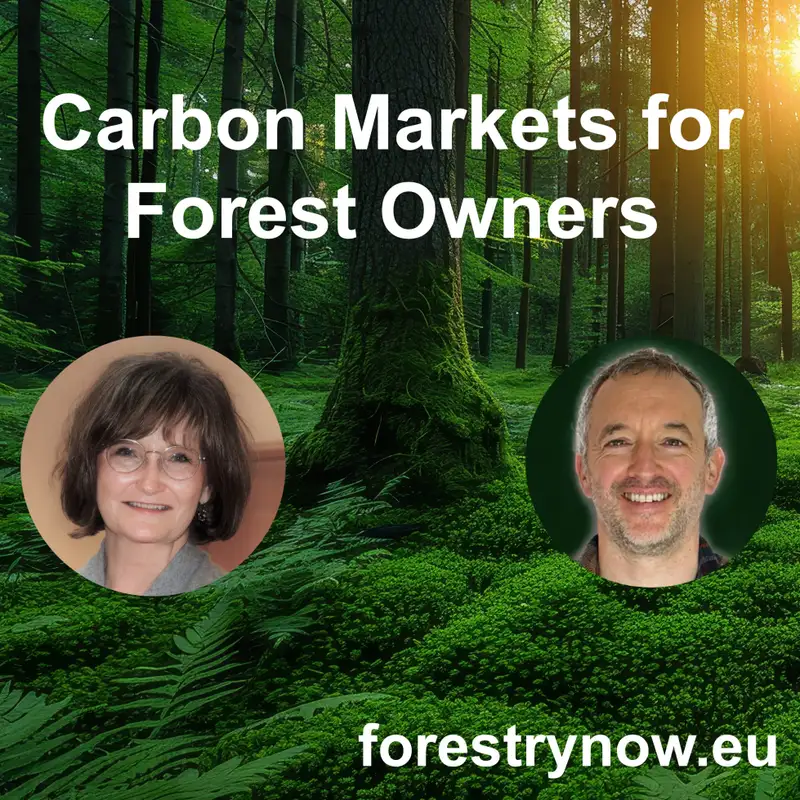
Carbon Markets for Forest Owners with Eeva-Liisa Heinaro
Download MP3Welcome to Forestry Now, where we explore the forces impacting profitable and sustainable management of commercial forests and natural woodlands. I'm Dermot McNally. Today, I speak with Eeva-Liisa Heinaro from Finland. She spent decades working in the paper industry before moving into Carbon Lab, who help businesses manage and monetize carbon sequestration and ecological compensation projects. Carbon Lab are a subsidiary of Conifer Consulting, who manage more than 135,000 hectares of Finnish forestry for institutional investors, so they really understand how forests work. In this interview, Eeva-Liisa explains a little about her background and the forestry sector in Finland. We then move on to discuss what's happening in carbon markets, and she explains how the institutional architecture around carbon has been rebuilt. We discuss key aspects of carbon project certification and the hurdles that forest owners will have to jump if they are to access this potential revenue stream. Now, here's Eeva-Liisa. Thanks very much for joining me.
Thank you for inviting me.
Maybe you'd start off by introducing yourself and then giving us an overview of what you do at Carbon Lab.
My name is Eeva-Liisa Heinaro. I have a long background working for the Finnish forest industry. But the past four years, I've been working within the voluntary carbon market, basically on the project developers side, concentrating on Finnish nature-based carbon projects. We have also been doing international projects, and now in the past year, we've been expanding into other carbon solutions, like direct air capture. We have been doing a project involving biochar
in the past 12 months. So basically, what we could say, I work with carbon-related projects that have a commercialization potential. So we do pre-feasibility studies, feasibility studies, financial evaluations of the projects, and so on.
And so yous are at the stage of actually commercializing some of these projects and selling some of the carbon solutions then?
Yes. I can comfortably say that I'm one of the few people in Finland who has actually sold a carbon project concept to the forest owners, and I have also been selling the carbon credits to companies. So I know what it takes to work through the whole chain.
Yeah. You're not just on one side of the fence, yeah.
No.
Okay. And I'm not very familiar with the Finnish forestry industry, so maybe before we get onto the carbon, you just give us a snapshot of the industry as it is at the minute.
If I start by painting the background Finnish forestry and forests are about, Finland is basically 75% of the surface is covered by forests. The main species that we have here are spruce and pine, and birch. Those make up about 95% of that forest surface. And the 75% of Finland in forest, that accounts or means about 23, 24 million hectares of forests.
Main soil for the forests is mineral soil. But then we also have almost five million hectares of former peatlands, peatlands that have been converted into forests through draining over tens of years. And I think this is something where we can draw a parallel with Ireland. I've understood that Ireland has considerable share of the forests are on peatlands.
Yeah, that's true.
And then, maybe a few words about the forest ownership. We have
about 60% of this forest area is owned by private individuals, about 600,000 of these private forest owners. So you can imagine that the size of the ownership varies from well over 10,000 hectares
down to very small lots, about five hectares or so. So it's very diversified.
Mm.
And for instance, I myself, I own a small patch of land, which is forest, because that's where our summer house is. So [chuckles]
we have all kinds of forest ownership. And then I think what is very characteristic for Finland is that we have a very long history of forestry. Organized and regulated forestry goes back over 100 years, and this means that we also have very detailed forest data of the growth year on year. All this data is then geographically split into,
I think it's three regions. We have the southern, the middle part, and then the north of Finland, where the conditions are completely different, which of course then affects the growth of forests. And all this is stored, and forest owners are also obliged to report their annual forestry proceedings, how much they have been felling and thinning, and so on. So what we do today is based on very robust historical data.
And just to question you on that part, is it all licensed, or is it a voluntary system of adhering to the rules?
It is based on regulation. Then we also haveToday, quite a high share is also certified forestry. In Finland, we use both PEFC, the more dominant certification method when it was launched, I think it was in the '90s, I believe, as a counterbalance to FSC at that time. But today, especially big forest owners, they hold both FSC and PEFC certificates. And those obviously bring a lot of regulation into how you can manage your forests.
The certification is really only getting going for private forest owners in Ireland at this point. And one other question then, are forests typically clear-felled, or are they managed on a gradual basis with continuous thinnings over long, extended periods?
I think when we talk about what we call commercial forests, those are forests that are used by the forest owners as an income source, and they are managed commercially, which means that they follow the rotation age of the trees, and then clear-felled in pockets and parcels, and then replanted. And I think especially the legislation on replanting is very rigid in Finland. Every forest owner who does a clear-felling is obliged to replant the areas so that we get constant regrowth. Continuous forestry is becoming popular or more popular. It's not a very big share yet, and I think one of the challenges there is that it's not as if you could turn your whole forest into a continuous forestry model because it's suitable for certain type of areas, and then there are areas which are not suitable for this type of forestry method. So it's gaining foothold in the south of Finland, I would say.
Well, that's a good overview of the Finnish industry for anyone who's interested. Let's move on now a little bit to carbon. And over the last couple of decades, there's been a lot of effort to create a reliable, functional carbon trading system, and there's been controversy and plenty of big promises along the way. But to bring it up to date then, can you give us an overview of what has happened in more recent times to strengthen carbon markets in Europe particularly?
One of the big changes that has happened in the last 10, 20 years is that regulation has been developed around the carbon market. It used to be quite unregulated and opportunistic in a way of how you create your carbon projects and how you get the most out of them. And this really led into situations where there were actually misuse of the system surfaced and created a lot of mistrust as well in the system. And I think in the last 10 years especially, I think the regulation and different controlling functions, checks and balances, have been built around the market itself, and I think those have been very important steps because that creates credibility, and credibility is really needed for the buyers to trust the system and trust that they actually getting what they are buying with their money. First of all, we have the organizations that kind of created the rules, like ICVCM and CCP and so on, that create the rules for what makes a trustworthy carbon project. We have ratings agencies, which is something that is actually very important because they are also checking that the projects actually follow the rules, and they
also rate the project according to quite strict protocols. And the better your rating, the more valuable the credits actually are. You could actually compare them with credit ratings agencies in a way.
Yeah, for banks or for individuals.
Yes. And then we have the certification bodies like Verra, Gold Standard. There is a number of North American players who have developed the methodologies for the carbon projects and classifications, and they have also become a very important controlling body for a carbon project. And today, having the credits certified, it's a prerogative for making sales. And then I think for Europe in particular, it's very important that also EU has come into the market as a certification providers. The CRCF framework for carbon has been in effect now for maybe a year and a half, and they are underway with three new certification methodologies for different types of carbon capture or carbon sequestration. When you as a carbon product developer, you have to work your way through all these steps in order to have a credible, solid carbon project. It also works in your favor because then you know that you have the stamp of approval from each one of them. Then you know that you are actually able to get, first of all,
financing for your project, which is needed definitely, but then you also have the opportunity to sell the carbon credits at a premium price.
So for a carbon project developer, it makes sense right from the beginning to build all this into your project plan.Because in the end, it confirms that you have a solid project.
Does this all make Europe a cut above some of the carbon offerings that are coming out of other less regulated countries around the world?
It gives a good competitive edge on the voluntary carbon market.
And I think one of the really strong features about European projects is that as a buyer, you can basically go to the lot and see for yourself where your carbon credits are produced. Distances are very short. The chain of custody is shorter. As a credit buyer, you have better oversight of what it is that you are buying, which I think is one of the upsides of European carbon projects.
Yeah. So you have the regulatory framework you're talking about that has been developed and a kind of a credit system or a rating system. It's not like if you do a carbon project in, we're going to say Brazil or Indonesia, it's not hard to trace it. And of course, all the European nations have quite strict rules around management of forests. So yeah, it sounds like it's a good competitive advantage. But does it equate, from what you've seen, into a higher price for those carbon credits then?
I would say it equates to, first of all, higher rating by the rating agencies. That means that there's also the potential of getting a better price, a higher price. It's very difficult, obviously, to give a price to say that this is how much you could get, because the projects are so different. But definitely, European projects tend to be rated higher in monetary value.
Just to bring you back a little bit, we talked about PEFC and FSC. In my mind, my simple mind, I think that those organizations seem to be in a natural position to maybe broaden their type of certification to cover some of the carbon issues. Is there a duplication of function there that, as a forest owner, we're going to have to certify it to get FSC or PEFC? And now we're talking about certifying it from a carbon point of view. Now, I know that there's a different expected outcome, maybe FSC, PEFC is timber output, and the other is a carbon or an ecosystem type
benefit. But is there a little bit of overlap? Does it cause an additional cost then, really? And how are forest owners reacting to this additional, I suppose, paperwork?
These two certificates, they actually support each other. The forest certification, it's actually a requirement in the carbon certification systems. So in order to have your forest in a carbon certification
project or a carbon project, it has to be certified by FSC or PEFC. And this is, for instance, the case with the Verra projects. So it's a prerogative here. I'm not able, obviously, to comment on what plans of these forest certification bodies are or how they see their own role. But I think you could say that they have their hands full with what they're doing currently. The one is needed to make the other happen.
Understood. Yeah, I get you. Yeah. You start off with forest certification, and then if you're interested and the forest suits, you can move on to thinking about the carbon.
Any queries or comments or interested in appearing on the podcast? Then email me at forestryknowpodcast@gmail.com. Also, if you haven't yet done so, please sign up to the newsletter in the links below. And finally, if you've enjoyed the podcast, please do like or share with colleagues. It's much appreciated. Now, back to Eeva-Liisa at Carbon Lab.
Let's talk about another concept that arises whenever I read about carbon payments and how it all works. The idea of additionality always comes into the conversation. Can you explain the concept of additionality and what part it plays in carbon or ecosystem type certification and payments?
Additionality is one of the two really core concepts when we talk about carbon projects. The other one is permanence. First of all, we talk about financial additionality, and then we talk about the actual measured additionality in a carbon project. That's the difference between what would be the baseline of the forest growing or sort of like continue as is scenario. Because you have to model out, first of all, how much the forest would grow even if you continue just as you would do. And then really the additionality or the carbon project scenario is calculating and measuring how much the forest grows more if the forest owner changes the way he maintains his forests. It can be through extending rotation age, which I think is the most common way of doing it, but it also can be by more selective thinnings, for instance, or in some cases even using fertilization to accelerate the growth of the forest and therefore then increasing the volume that it is growing. So the carbon additionality is the difference between the baseline, the as isAnd then what happens when you, as a forest owner, change your forestry
so that there's actually more trees, more wood growing in the forest. And it's only this little difference between these two lines, which is a carbon project. That is what you actually convert into tons of CO2, and those are the ones that you certify because you are following a certain methodology. That is the part that you can actually sell. And then the financial additionality
is another way of making sure that you are actually doing a carbon project instead of just continuing as is. And that means that you have to estimate and prove that this carbon project would not happen without the additional income from the carbon project. For instance, in terms of if you extend the rotation age, it means that you earn less from your forest, you sell less timber, and the carbon income then supplements your income,
so that you're actually not covering necessarily all of your losses, but anyway, it makes it more financially viable to do. A third dimension of additionality is that whatever you do, it has to be voluntary. If you are obliged by law to do something, it is not counted as additionality. I think it is a very strong requirement to a forest owner to really decide that, "Now that I'm going to do a carbon project, I have to follow this protocol."
Yeah. No, and just to give you a little bit of feedback, I am a forest owner. I speak to other forest owners, and there is a perception at times that we can do business as usual, and that someday there will just be carbon payments for not changing our forest management styles. Effectively, we plant the trees, and we cut the timber. But what you're saying here is that we have to do something in addition to store carbon in a better or a more permanent way. It has to have a financial burden on us that means that we have some loss of income, therefore, we need payment to help us take this positive action. And the last one you mentioned was, again-
Whether it is voluntary or whether it is by regulation.
Okay.
One more.
So in that scenario, if the government mandates that we need to continually improve biodiversity areas in our forest as a standard replanting measure after a clear fell, then that's not an additionality if it's a government requirement or a regulatory requirement that we would have had to obey anyway. Is that right, Eeva-Liisa?
Basically, yes.
And you also mentioned permanence then. Just what can you say about permanence?
That means for how long the additional carbon is stored in the forest or other solutions. But it means that the forest owner, they have to also commit to the project. You have to commit yourself to continue with a carbon project for up to 30 years, I think it is, for improved forest management, for instance. Obviously, the buyers of the credits, they expect carbon credits exist for as long as possible. That is, I think, the aim with all
carbon capture is to obviously take away the CO2 from the atmosphere,
either for good or for as long as possible. Here, we have to understand that obviously, nature-based carbon projects,
they have by definition a shorter
permanence concept than the other methods like direct air capture, where you take the carbon out from the atmosphere and transform it into a permanent material that can be, for instance, used or inserted into the ground where it's possible and stored for thousands of years. For a carbon credit buyer to understand that this is a very fundamental difference between the nature-based, they cannot be forever. And then there's the permanent carbon capture, which is forever, basically. And this difference is also reflected in the price of the carbon credit. The permanent carbon capture solutions today, the carbon units, they can cost anything from 500
euros per ton up to 1,400, 1,500 euros per ton because the technology you need is so expensive today. And then obviously, nature-based solutions, depending on the project, that can be between 10 euros per ton up to 150 euros per ton. For instance, biochar credits are quite expensive, 150, 100 to 200 euros per ton. Depending on the methodology that you use, that the price is then theThe scale is very wide.
Yeah, for a typical forest-
Yeah
... that's sequestering carbon. And just to put those figures into, I know they're very broad, but on a per hectare basis, does it ever come down to that, that you're roughly thinking that it's going to be worth X per hectare or per year, or how is that figure played out over an extended period?
Forest carbon projects, you can calculate them carbon income per hectare. I'm not really comfortable with giving any indications of what the price can be, because it depends so much on what kind of forest you have, with the density of trees on your hectare. It's very individual. Each of the forest portfolios, they have to be analyzed.
Individually, yeah.
And I suppose that is a challenge in that it's a necessary evil of the system that there has to be a very rigorous scientific assessment of all those factors so that the buyer of the carbon credit can be comfortable and know that this credit will really deliver what it says and there aren't unverified claims then. So it must be expensive enough then to actually engage in, for forest owners who want to get involved. It's a big commitment in terms of time and money then, I presume, Eeva-Liisa.
It is a big commitment. Money-wise, it can get very expensive because you have to have a very solid analysis done, and the calculation methods have to be developed for each project. And then, of course, you have to do the yearly reporting.
And then there has to be auditing that your process and your methods have been properly done. And then there's also the certification process that you have to go through. So it can easily get very expensive. That's why for a private forest owner to get certification and get a carbon project going, you would have to have tens of thousands of hectares to make that viable.
Yeah, I know that the only reflection on that I can give is that the certification program for Irish forests is being done on a group basis to help spread the cost of FSC or PEFC certification, because our forests are anything from eight hectares up to 50 or 80 hectares for private forest owners. 50% of our forestry estate is owned by Coillte, who's a body of the Irish government. But otherwise, it's a lot of small owners, and the decision has been made that we work together as a group. So I think, from what you're saying, best case scenario is that small owners will have to pool their resources if accessing carbon markets is even a possibility. You mentioned earlier in the conversation that there's, I think, five million hectares of forestry in Finland that's planted on peat soils. Now, here in Ireland, we hear lots of discussion around the relative benefits of leaving peat alone and not putting trees on top of them. And we're not allowed to plant on deep peats anymore, for the reason that it's generally accepted that planting on deep peat is releasing more carbon than it's gaining, even though it may grow timber. But if someone comes to Carbon Lab with a portfolio of forestry that's predominantly planted on peaty soils, do you look at that and think that there's less chance that this is going to be a very viable carbon project because just the ecology of growing timber in a peat soil that should be sequestering carbon anyway isn't as attractive as a mineral soil type project?
Peatland forests, today there is no applicable certificate available or methodology for certifying peatland forests. There are developments going on. You really sort of hit the nail in saying that the risks involved with peatlands is really that you cause more negatives than positives with your carbon project,
with the soil emissions. We have to find ways of
working around those risks. It is a big issue also in Finland, how to treat or how to restore the former peatlands into peat again, because we have also used peat here for heating, for electricity, and then we have excavated a lot of peat over tens of years. And that is one of the challenges we have here in Finland, to work out the methodology, how to re-wet successfully the peatlands without destroying the ecosystem, the balance in the peat.
Yeah, that's a challenge for us as well. And I think that on a forest that's very unproductive, that's been planted onto peat, that's not growing very fast, it becomes an easier decision for the owner to say, "Well, this isn't benefiting me from a timber revenue point of view, so perhaps there's an alternative." And the challenge just lies in that gray area where the soil has a certain amount of peat, but it's still producing a good commercial crop of timber, and that's a trickier place to work in. And alsoOur peat bog areas and our deep peat areas tend to be associated with vulnerable species, certain types of birds, and so that brings an additional pressure to revert those areas to a way that will benefit not only carbon, but also some of those endangered species. So, okay. Well, that's interesting because, again, these are the real things that are cropping up in the Finnish situation, and I think they're all very relevant to Ireland here as well.
So you had mentioned that you had sold
a scheme to forest owners and to an investor, and could you just even give us a
one-minute overview of what that process looks like for the owner and the investor, and how long it took? What has the owner committed to doing in that particular scenario?
The forest owner has to commit
beforehand to doing a carbon project. I think the best way of getting around getting started is to contact a carbon project developer who is the professional in doing the
forest portfolio analysis, determining what is the baseline, what is your additionality line, and then giving you all the parameters of how to go about it. Today, I think in Europe, there are also professional carbon project developers who do the operation for a forest owner. So I would really recommend, especially for a smaller forest owner, to get in touch with carbon project developers. Or what they are doing is they are also pooling the forests into their project, which then gets a certificate. That is a very good option for a forest owner to work. Doing forest carbon projects on your own is really
demanding.
Yeah. We had also chatted very briefly about an example in Estonia where something like this is being tried. It may be at pilot stage, but can you speak about that at all, or where can we find out more about that?
There's now a carbon project developer operating from Estonia, actually the first one in Europe to have got a Verra certificate for their afforestation project. They operate over Europe with some exceptions. One of the requirements is really that you have to have available forest data
in an XML format to be able to participate in the project. But they have been successfully working on the afforestation project now for two years, developing it. They're also developing now an improved forest management pan-European project. They are the first one who have actually gone so far with their concept.
And have they reached market yet with those credits? Because I understand that what we're talking about here, it must take time
from the initial conversation with a forest owner. If everything goes right and there's something positive at the end, there must be a fair time lag between starting the process and hoping to reach market with the carbon credits.
There definitely is, and this company has. They have actually gone to market with the first, I would call, first crop of carbon credits, because one thing that is really important also to remember is that the carbon income is calculated year on year.
So you only get carbon income for the one year's worth of additional growth. Then it is again recalculated the following year. For a forest owner who has submitted a carbon project end of '25 will get first carbon income in the beginning of '27 only, and also, I think in
afforestation or reforestation projects. That's the common practice nowadays.
There's one other question. I always have one more question, but I have one more question, which is that,
let's take a scenario where there's an act of nature, which is a windstorm or a fire, and five years into your carbon project, half of your area has been irreparably damaged. Is there a kind of a standard mechanism how that's built in for contracts, or is it just the case that the project ends and the owner gets no more payments, and the carbon credit then is no longer functional because it no longer exists?
There's a concept of having a buffer for incidents like this. From your yearly carbon amount, if you have 100 carbon units from one year, then depending on the certification rules, a certain amount is put aside into a buffer.
And it can be 10%, 20%, depends on the certificate. And then the buffer comes to use if something happens, a nature catastrophe. So part of the buffer is used to compensate for the loss towards the buyers for the loss of the forest. For a forest owner, obviously, it means that there will be less income to you because you are producing less carbon units.And the aim of the buffer is really to protect the buyers from losing their investments into carbon.
Yeah, understood. I think we've covered a lot of the overview to give owners and people like myself just a general feel for it, because I think, having done some other reading, I think each of these areas, we could spend a podcast exploring each of them. But I think we have a good feel for it now from what you've told us. Anything else then, Eeva-Liisa, that you see coming down the track in the next while that's going to maybe change something we've discussed or add an additional layer of complexity? Is there anything immediate that has been announced that we need to be aware of?
We were touching on this briefly when we were talking about the peatlands and the challenges there. Another road to take is really to go down this ecological compensation
road for
restoring peatlands. That's something that is very much up and coming now, and it is a way of compensating for an industry, for a company who does damage to the nature.
Ecological compensation is a way of, as it says, compensating for the damage by investing an amount of money into another piece of land. There's a very rigorous calculation rule that has been built around how you calculate the damage that you have done, that you're doing, and what kind of investment you have to put into another plot to repair and to compensate for the damage. And I think that this is something that is being discussed, at least in Finland, very much in connection with the peatlands, to do ecological compensation, re-wetting the peatlands so that they will restore the ecological conditions and the biodiversity of the land. So this is something that if you don't feel you have a carbon project, you could actually always look into ecological compensation as well.
As an alternative, yeah.
As an alternative. Basically, what you do with ecological compensation is really
important and valuable.
That's a good point to note.
I wonder,
is any of this making the timber industry nervous? Because if the ecological compensation is strong, perhaps there's a chance that large areas that are forestry could be converted back to carbon sequestering areas and the timber industry would have less of a supply of crop. Has that been talked about, or is that an issue?
That is something that is being discussed in Finland. I think it's good to discuss all aspects around these projects, and especially in a country
like Finland, who has always depended then on forestry so much. It is very important that we listen to all parties involved, and we also try to understand their argumentation for why things should not be changed or should be changed in a different way than what we would actually like to see, and then find a balance between all these solutions or opinions. It's hard. In a country like Finland, where almost everybody has a plot of land somewhere, everybody has also very tight emotional ties to the forest, and we give forest a lot of meaning, which goes beyond just the financial value. I think the emotional values of forests to Finnish people are very
important to take into account in all these discussions.
Oh, brilliant.
Okay. Well, Eeva-Liisa, thanks very much.
Thank you.
Thanks again to Eeva-Liisa at Carbon Lab for taking the time to chat. As always, you can find relevant links and contact details in the show notes below. Thanks again for listening.