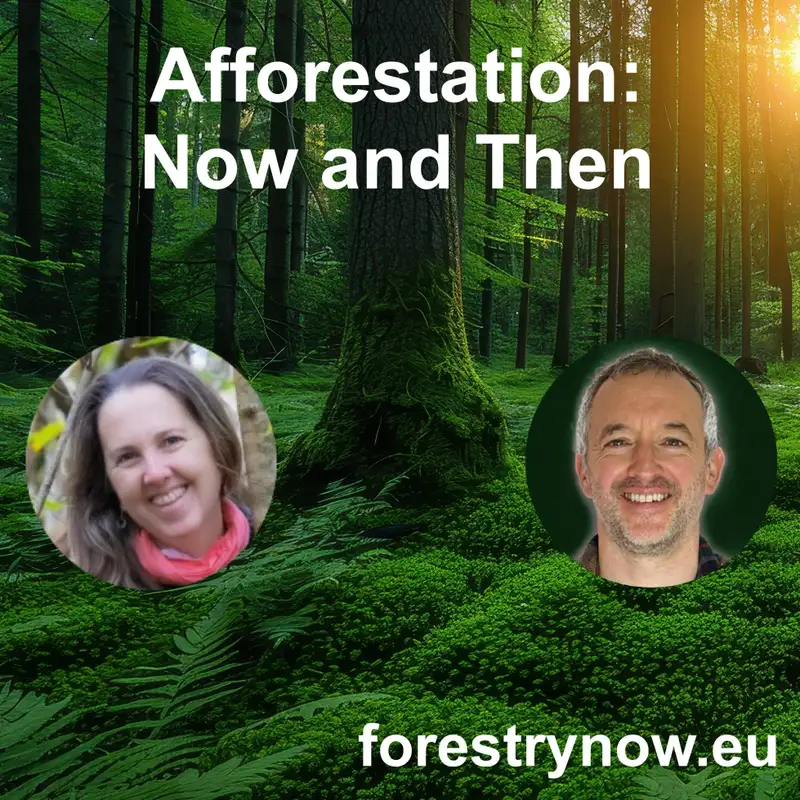
Afforestation: Now and Then with Marina Conway
Download MP3Afforestation: Now and Then with Marina Conway.
A deep dive into how we screen all new afforestation applications in Ireland and how this process compares with the process in the past.
In this interview I'm joined by Marina Conway, Head of Woodlands at Hometree and one of Ireland's most recognisable and respected forestry professionals. We speak about the afforestation screening process and the type of habitats and landscape features they protect, we hone in on water quality and the treatment of applications on peaty soils and from hen harrier areas. Then we also talk about modern operation techniques that are used during planting to protect water and biodiversity. During the conversation we look at how things were done in the past and Marina flags problems we're still dealing with. And then we look forward and Marina makes interesting recommendations to increase afforestation and stakeholder engagement.
Marina is a qualified forester and is currently Head of Woodlands at Hometree. She is also a Nuffield Scholar, former CEO of Western Forestry. She also worked internationally in Government in New Zealand on Forestry in the Emissions Trading Scheme. She has spent the majority of her career in farm forestry, her passion is for farmers, farm families and communities being at the centre of our national forestry policy and that our forests are best served in local and rural ownership. She is especially proud of leading on Ireland’s first Woodland Festival, largest Native Woodland Park and first pioneer birch woodland. She has participated in national committees on forestry including appointed by the Minister to Project Woodland. Marina has a Degree and Masters in Agricultural Science (Forestry), qualifications in Environmental Auditing, Training and Water Pollution Control and is a 2025 Nuffield Scholar.
This podcast is supported by the Irish Department of Agriculture Food and the Marine. If you're thinking of planting a new forest or if you want information on financial and technical supports to manage your existing forest then go to
A deep dive into how we screen all new afforestation applications in Ireland and how this process compares with the process in the past.
In this interview I'm joined by Marina Conway, Head of Woodlands at Hometree and one of Ireland's most recognisable and respected forestry professionals. We speak about the afforestation screening process and the type of habitats and landscape features they protect, we hone in on water quality and the treatment of applications on peaty soils and from hen harrier areas. Then we also talk about modern operation techniques that are used during planting to protect water and biodiversity. During the conversation we look at how things were done in the past and Marina flags problems we're still dealing with. And then we look forward and Marina makes interesting recommendations to increase afforestation and stakeholder engagement.
Marina is a qualified forester and is currently Head of Woodlands at Hometree. She is also a Nuffield Scholar, former CEO of Western Forestry. She also worked internationally in Government in New Zealand on Forestry in the Emissions Trading Scheme. She has spent the majority of her career in farm forestry, her passion is for farmers, farm families and communities being at the centre of our national forestry policy and that our forests are best served in local and rural ownership. She is especially proud of leading on Ireland’s first Woodland Festival, largest Native Woodland Park and first pioneer birch woodland. She has participated in national committees on forestry including appointed by the Minister to Project Woodland. Marina has a Degree and Masters in Agricultural Science (Forestry), qualifications in Environmental Auditing, Training and Water Pollution Control and is a 2025 Nuffield Scholar.
This podcast is supported by the Irish Department of Agriculture Food and the Marine. If you're thinking of planting a new forest or if you want information on financial and technical supports to manage your existing forest then go to
Key Points:
- Environmental assessment processes for afforestation in Ireland
- Protection of water and biodiversity in land management
- Native woodland restoration and ecological connectivity
- Community engagement and public support for forestry
- Challenges with peat soils and carbon balance
- Future strategies for sustainable land use including - increased community engagement and reconsidering peat depths which can be planted.
Quotes:
- "We have a lot of ambition in this country for forestry."
- "Young spruce provides nesting habitat for hen harriers."
- "Rewetting peatlands can be a part of our climate strategy."
- "The state got it right in saying we need to become self-sufficient in timber in our own country."
- Time to reconsider planting deeper peats? "Absolutely...it's carbon reasons that the thirty centimetre came in and it's a little bit arbitrary. I mean I don't know how much you know I think there is there is research going on now to to look into that a little bit more because it's forty centimetres in England, it's fifty centimetres in Scotland.."
- "One of the things that that always frustrates me a little bit about the appropriate assessment screening process that is required under the Habitats Directive is that it doesn't take any cognizance of existing land use.... we can go in and do a two-year study on converting 40 acres into a native woodland. And I'm not joking, applications can take two or three years to be done. Yet the existing landowner can continue to farm that land, to spray rushes, to put on fertilizers, to dose their sheep, to, you know, to you know drain it."
Click here for the ForestryNow podcast newsletter signup
Follow the Guest on:
Marina Linkedin: https://www.linkedin.com/in/marina-conway-01670312/
Marina at Hometree: https://www.hometree.ie/about
Project Woodland Report: https://assets.gov.ie/static/documents/project-woodland-final-report-january-2023.pdf
Other Links of Note:
New Zealand Emissions Trading Scheme: https://environment.govt.nz/what-government-is-doing/areas-of-work/climate-change/ets/
Follow the Forestry Now Podcast on:
Website: https://forestrynow.eu/
Linkedin https://www.linkedin.com/company/the-forestry-now-podcast/
YouTube: https://www.youtube.com/@ForestryNow
Instagram: https://www.instagram.com/forestry_now_podcast/
Facebook: https://www.facebook.com/ForestryNowPodcast/
Contact Dermot:
forestrynowpodcast@gmail.com
Or at Linkedin: https://www.linkedin.com/in/dermot-mcnally-90b06421/
Chapters: 0:00 Dermot introduces todays guest
01:04 Introducing Marina Conway and her forestry career
02:24 How the afforestation screening process works
05:10 Natura sites, water quality and environmental safeguards
09:14 Water setbacks, drainage and protecting waterways
11:20 Peat soils, carbon and the legacy of past planting
14:34 Protecting birds, habitats and high-nature-value farmland
18:44 How forestry rules have changed over the years
21:20 The environmental legacy of planting deep peat
26:30 Modern forestry: less fertiliser and better planting techniques
29:09 Hen harriers and the changing forestry landscape
32:21 Replanting, continuous cover forestry and forest-to-bog conversion
39:10 Biodiversity areas, riparian woodland and protecting water
43:54 Forestry and the local community
46:59 How can Ireland plant more forests?
54:14 Finding the balance between environmental protection and forestry
56:05 Should deeper peat soils be considered for forestry?
58:46 A more holistic approach to land management
59:29 Conclusion